 How-to
How Often Is Backflow Testing for Industrial Facilities?
Last Updated: October 30, 2026
Quick Summary
Most industrial facilities need annual backflow testing of each backflow prevention assembly, the common baseline under municipal requirements. High-hazard connections may need testing more often, and newly installed or repaired devices usually need a test right away. Confirm the exact interval with your water purveyor, since local rules can add their own schedule.
- Back-siphonage and backpressure are the two ways backflow sends contaminants into potable water.
- An RPZ uses two check valves plus a relief valve and suits high-hazard connections like chemical lines.
- A first check valve on an RPZ typically must hold at or above 5.0 psi to pass.
- Group devices by water dependency so critical processes get after-hours testing or a permitted bypass.
- After testing, flush the line, verify pressure, check for leaks, and document restoration in your maintenance log.
Table of Contents
- Why Backflow Testing for Industrial Facilities Is Not Optional
- How Backflow Prevention Assemblies Work on an Industrial Site
- Backflow Testing Frequency: What Industrial Facilities Should Expect
- Step-by-Step: What Happens During a Backflow Preventer Inspection
- Reading the Backflow Test Report Form and Pass/Fail Criteria
- Building a Cross-Connection Control Program That Holds Up
- When an Assembly Fails: Repair, Retest, and Keeping Operations Running
- Scheduling Industrial Backflow Testing Without Downtime
- Frequently Asked Questions
Why Backflow Testing for Industrial Facilities Is Not Optional
Backflow testing for industrial facilities is the scheduled verification that the devices protecting your water supply actually work. A failed assembly can pull chemicals, process water, or bacteria straight into the drinking water line.
Backflow is the unwanted reverse flow of water or other liquids into the potable water supply.
Industrial sites carry hazards most buildings never touch:
- Chemical feed lines and process tanks
- Cooling towers and boiler systems
- Fertilizers and irrigation connections
A single cross-connection between a process line and the water supply can turn a routine day into a contamination event. The EPA's cross-connection control guidance treats protecting drinking water as a core public health duty.
How Backflow Prevention Assemblies Work on an Industrial Site
A backflow prevention assembly is a mechanical barrier that allows water to flow one direction only. When pressure reverses, the device closes and blocks contamination from reaching the potable water line.
The two most common assemblies on industrial property:
- Reduced-pressure principle assembly (RPZ): Uses two independent check valves plus a relief valve. The relief valve opens and dumps water if differential pressure drops too far. This is the go-to device for high-hazard connections like chemical lines.
- Double-check valve assembly (DCVA): Two check valves with no relief valve. It suits lower-hazard connections where a chemical spill is unlikely.
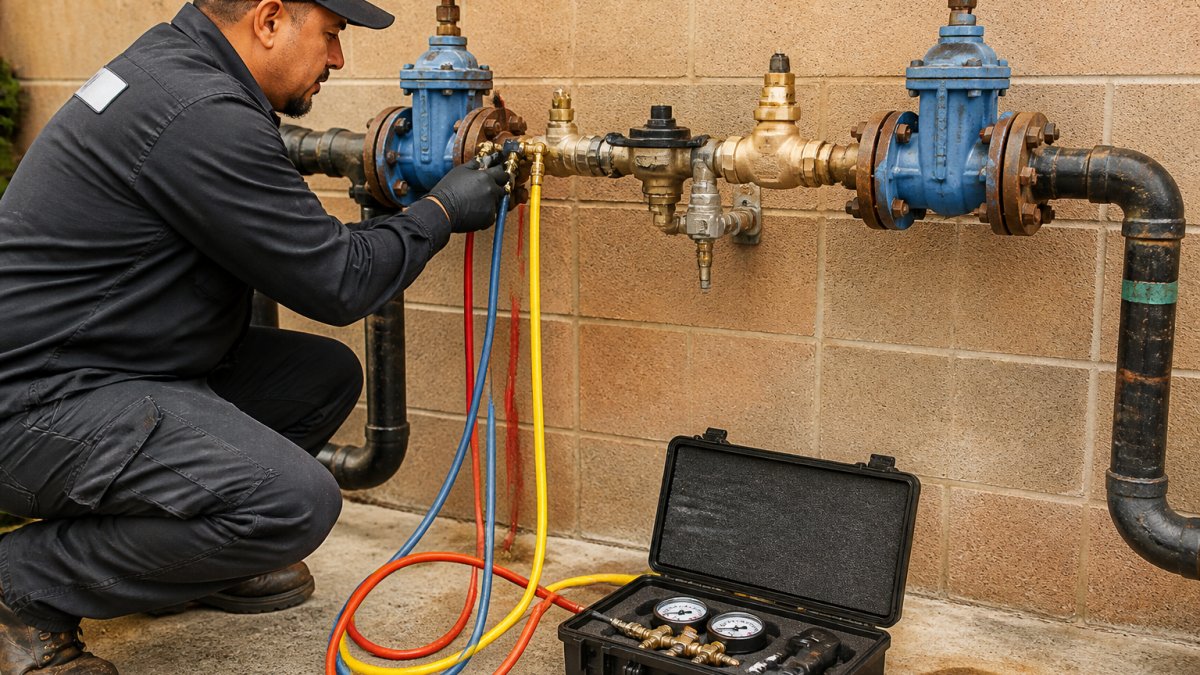
Every assembly has small test cocks and shutoff valves that let a certified backflow tester check the pressure differential across each valve. A differential pressure gauge reads those values, and the numbers decide pass or fail.
Backflow Testing Frequency: What Industrial Facilities Should Expect
Most industrial facilities need annual testing of each backflow prevention assembly. That is the common baseline under municipal requirements, though high-hazard devices and some local rules call for more frequent checks.
Here is the practical picture:
- Annual inspection is the standard for most assemblies.
- High-hazard connections may need testing more often.
- Newly installed or repaired devices usually need a test right away.
Backflow testing frequency is set by your local authority, not by preference. So confirm the exact interval with the water purveyor that serves your site.
Here is the testing schedule the article describes for industrial backflow assemblies.
| Situation | Testing frequency | Note |
|---|---|---|
| Most industrial assemblies | Annual testing | Common baseline under municipal requirements |
| High-hazard connections | More often than annual | May need more frequent checks |
| Newly installed or repaired devices | Right away | Usually need a test immediately |
| Water purveyor rules | Set by local authority | Can add their own schedule |
Step-by-Step: What Happens During a Backflow Preventer Inspection
A backflow preventer inspection follows a set sequence so the test results are accurate and repeatable. For a fuller walkthrough of the inspection process, see our step-by-step guide to what happens during a backflow inspection.
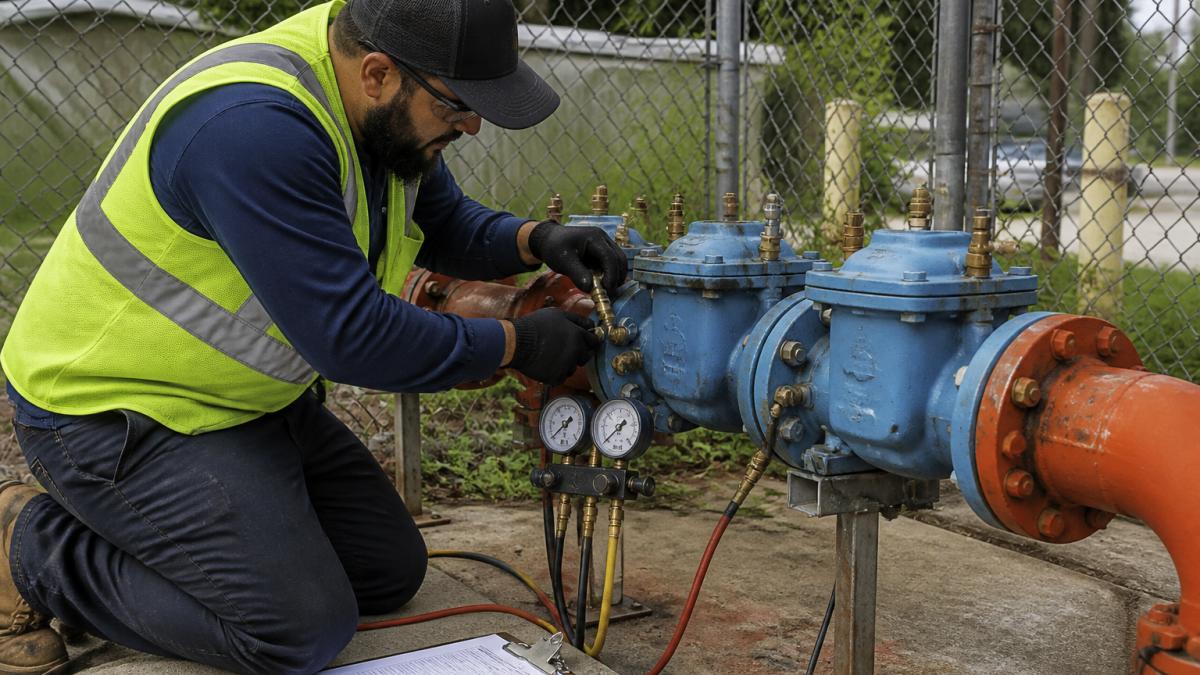
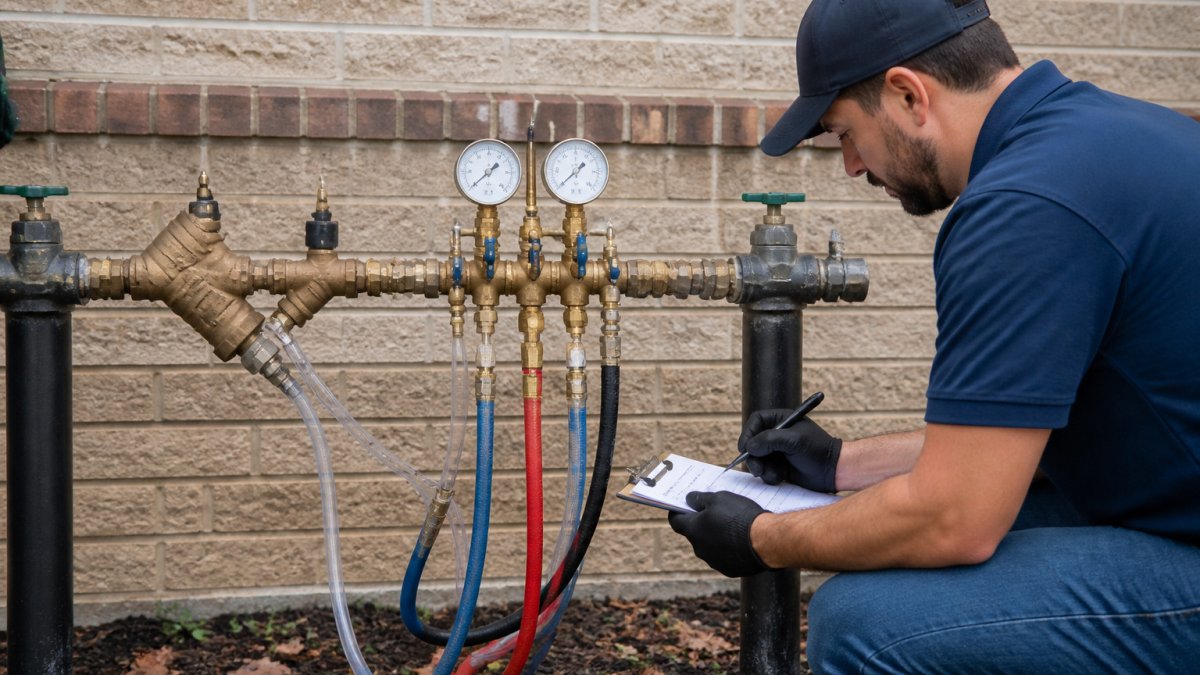
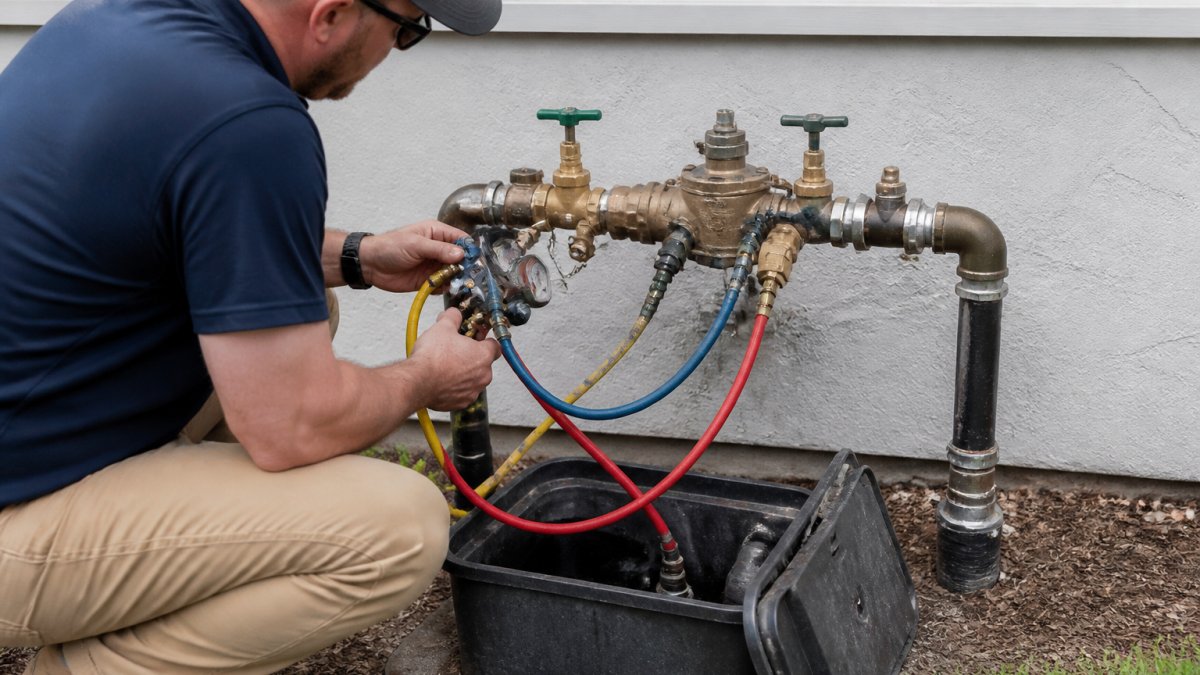
- Confirm the device. The tester matches the assembly to your records and checks the make, model, and size.
- Set up the gauge. Hoses connect the differential pressure gauge to the test cock points.
- Check each valve. The tester measures the pressure differential across the first check, second check, and relief valve.
- Compare to limits. Readings must fall within the performance limits for that device.
- Record results. Every value goes onto the backflow test report form.
- Restore the system. The tester closes the cocks and returns the assembly to service.
The USC Foundation for Cross-Connection Control publishes the field test procedures testers follow. A clean test usually takes well under an hour per device.
Reading the Backflow Test Report Form and Pass/Fail Criteria
The backflow test report form is the document that proves your device works, but its real value lies in the numbers behind the pass or fail. Industrial facility managers who understand how to read those numbers can spot failing trends before a device fails outright, prioritize repairs, and defend compliance decisions to auditors and the water purveyor.
What the Readings Actually Mean
A certified tester records specific pressure differential values for each component of the assembly. For a reduced-pressure principle assembly (RPZ), the critical readings are:
- First check valve: The pressure differential across the first check must typically hold at or above 5.0 psi to pass. A reading below that indicates the check is not seating properly, allowing potential backflow.
- Second check valve: The second check must also hold a minimum differential, commonly 1.0 psi or higher depending on the device and local requirements. This check provides a backup barrier if the first check fails.
- Relief valve: The relief valve must open within a specified range, typically when the differential across the first check drops to around 2.0 psi. If it opens too early, it wastes water and signals a worn spring or debris; if it opens too late, it fails to protect the supply.
For a double-check valve assembly (DCVA), the test focuses on the two check valves, each of which must hold a minimum differential, often 1.0 psi, to pass. There is no relief valve to test.
These thresholds come from the USC Foundation for Cross-Connection Control field test procedures and are adopted in most water purveyor ordinances. However, always confirm the exact limits with your local authority, as some jurisdictions set stricter requirements.
How to Interpret a Marginal Pass
A device that passes at exactly the minimum threshold is technically compliant, but it may be on the edge of failure. A common pattern in industrial settings is a first check that reads 5.1 psi one year and 5.0 psi the next, still passing, but trending downward. Smart facility managers track these values year over year and schedule proactive maintenance when a reading approaches the limit, rather than waiting for a hard fail that forces an unplanned shutdown.
What Belongs on a Complete Report
A defensible report should include:
- Device make, model, size, and serial number
- Test gauge calibration date and serial number
- Each test value and the limit it was checked against
Keep these records for at least the retention period required by your water purveyor. Organize them by device and location so you can quickly retrieve them during an inspection or when a device fails and you need to show a history of compliance.
From Report to Action
The report is not just a compliance artifact, it is a maintenance roadmap. A failed relief valve reading might mean a simple spring replacement; a failing second check could indicate debris that requires disassembly and cleaning.
Building a Cross-Connection Control Program That Holds Up
A cross-connection control program is your facility's written system for finding every hazard and keeping each device tested. The strongest programs share a few traits.
Start with a full device inventory. Walk the site and log every assembly, its location, hazard level, and test date.
Build in these habits:
- Track testing frequency for each device in one place
- Assign one person to own compliance records
- Schedule tests before deadlines, not after
For industrial sites with complex piping, our guide on preventing cross connection in industrial sites digs into the details.
When an Assembly Fails: Repair, Retest, and Keeping Operations Running
A failed test is common and usually fixable. The device needs repair, then a retest to confirm it now passes.
Device failure often traces to debris, worn seals, or a relief valve that opens too early.
Plan for these realities:
- Keep spare parts or a backup device on hand
- Know which failures you can fix same-day
- Budget for maintenance and retesting each year
Our breakdown of common reasons backflow tests fail helps you spot problems before they cost you a second visit. Quick repair keeps your water supply protected and your operations moving.
Scheduling Industrial Backflow Testing Without Downtime
Timing is where industrial testing gets tricky. Testing can require a brief water shutdown at the device, so plan around production, not through it. If you are unsure whether testing requires shutting off water, read does backflow testing require water shutdown. That single fact drives most scheduling decisions, but a facility-wide plan requires more than just picking a quiet hour.
Map Devices by Water Dependency
Start by grouping every assembly by the process it protects. A cooling tower make-up line, a boiler feed connection, and a chemical dosing station each have different tolerances for interruption. Rank them:
- Critical (no interruption): Devices serving continuous processes, sterile operations, or high-value production. These need after-hours testing, a temporary bypass (where permitted by the water purveyor), or a redundant assembly.
- Semi-critical (short interruption acceptable): Devices on lines that can pause for 30-60 minutes with planning. Schedule these during shift changes or planned maintenance windows.
- Flexible (easy to isolate): Devices on non-process lines, irrigation, or fire protection loops that can be tested during normal hours with minimal impact.
Coordinate with Production and Maintenance
A common pattern is to hold a monthly scheduling meeting with production supervisors and maintenance planners. Bring the device inventory and flag any assembly due for testing in the next 60 days. Production can identify upcoming changeovers or low-demand periods; maintenance can confirm whether a shutdown affects other systems (e.g., fire protection, HVAC). This prevents the classic mistake of scheduling a test during a peak production run because the tester had an opening.
Plan for Safe Water Restoration
After testing, the assembly must be returned to service and the water line restored. This is not just a matter of opening a valve. Industrial lines can accumulate sediment or air during a shutdown. A safe restoration sequence includes:
- Flush the line downstream of the assembly to clear debris and air.
- Verify pressure at the nearest gauge or test cock.
- Check for leaks at test cocks and shutoff valves.
- Confirm water quality if the line serves a process that is sensitive to contaminants (e.g., rinse water, boiler feed).
Document the restoration in your maintenance log. If a process line was opened, consider a brief water quality check before resuming production.
Bypass and Temporary Supply Options
Some facilities use a temporary bypass to keep water flowing during testing. This is only allowed if the water purveyor permits it and if the bypass itself includes adequate backflow protection, often a portable RPZ or an air gap. Never bypass a backflow assembly without written approval and a plan for protecting the supply during the test.
Build a Buffer and a Backup Plan
Even the best-planned test can run long if a device fails and needs repair. Build a buffer into the schedule, at least one hour per device, and keep a spare assembly or repair kit on hand for high-hazard connections.
That is where H-Town Backflow fits. We offer night and weekend appointments and flexible scheduling built to prevent water service interruption. Our team serves the City of Houston and many surrounding municipalities.
Frequently Asked Questions
What does backflow testing involve at an industrial facility?
A certified tester connects a differential pressure gauge to the assembly's test cocks and measures pressure across each check valve and the relief valve. The readings are compared with the manufacturer's performance limits to confirm the device holds against back-siphonage and backpressure. The tester then completes a backflow test report form.
How often should industrial backflow preventers be tested?
Most municipal programs require annual backflow testing, and industrial facilities with high-hazard connections may face stricter schedules or additional assemblies. Your water purveyor sets the actual backflow testing frequency, so confirm it in writing rather than assuming a single annual date covers every device.
Who is qualified to test a backflow preventer?
Only a certified backflow tester licensed in your jurisdiction should test an assembly. Certification requires passing an approved course and, in many areas, holding a plumber's license or working under one. Ask for the tester's certification number and the company's license before booking. H-Town Backflow holds BP # 0024323, and you can verify a tester's credentials with your local water purveyor.
Can backflow testing interrupt industrial operations or water service?
Testing often requires shutting the device's isolation valves, which can interrupt water flow on that line. Scheduling during low-demand periods, nights, or weekends limits the impact. Facilities with multiple assemblies can have them tested in sequence so critical process lines stay online. Ask the tester about after-hours appointments to avoid production downtime.
Protecting an industrial water supply takes more than a calendar reminder. It takes a program, the right records, and a tester who shows up when your operations allow. H-Town Backflow brings flexible scheduling, night and weekend appointments, and coverage across the City of Houston and nearby municipalities to keep your systems compliant and your water safe. Get started with H-Town Backflow and keep every assembly tested, documented, and running without downtime.