 ultimate-guide
After Hours Backflow Testing Services: What to Expect
Table of Contents
- Why After Hours Backflow Testing Services Prevent Downtime
- Signs Your Property Needs Backflow Testing Now
- Backflow Assembly Testing Requirements in Your Municipality
- Backflow Preventer Testing Procedure: Step by Step
- Annual Backflow Certification Cost: What Affects Your Bill
- After-Hours Surcharge Transparency: What You Should Know
- DIY vs. Professional Backflow Testing: Why Certification Matters
- Troubleshooting Common Backflow Test Failures
- Frequently Asked Questions
Last Updated: September 30, 2026
Why After Hours Backflow Testing Services Prevent Downtime
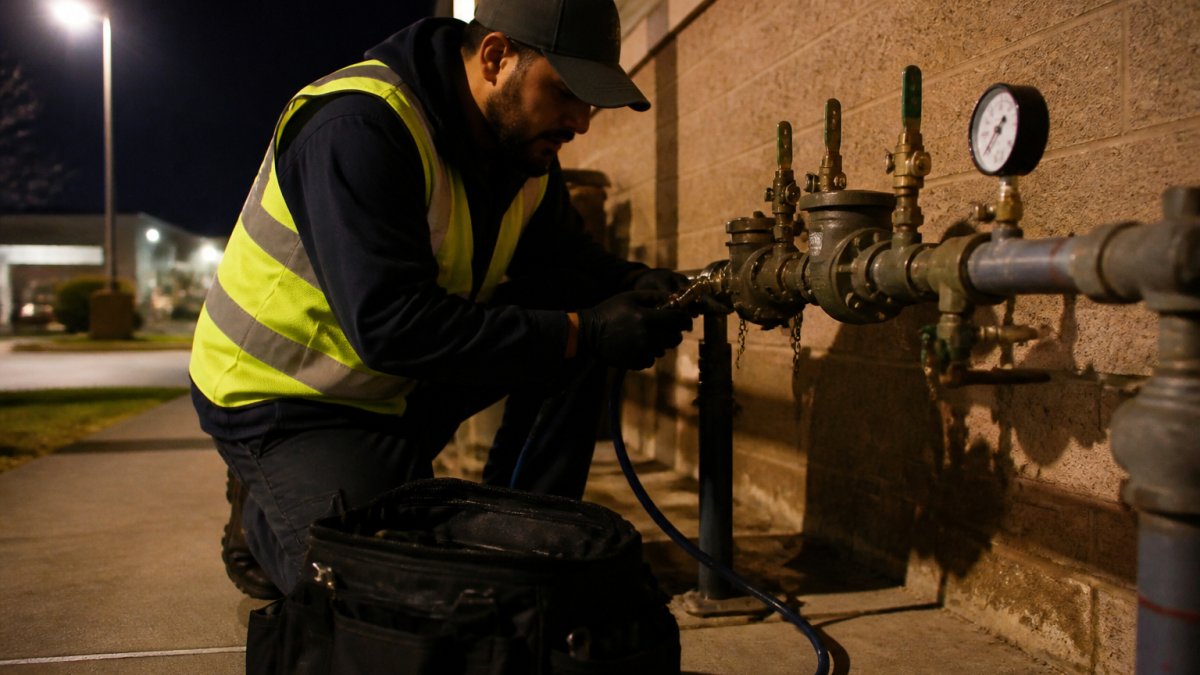
After hours backflow testing services exist because water shutdowns don't respect business hours. A failed backflow assembly test can force a utility to cut water service until repairs and retesting are complete, and for a restaurant, clinic, or apartment complex, that means closing the doors. At H-Town Backflow, we schedule night and weekend appointments specifically so testing happens when tenants and customers aren't affected, ensuring your operations continue without water service interruption.
The stakes go beyond convenience. Backflow prevention protects the potable water supply from contamination caused by back-siphonage or back-pressure, and a cross-connection control program only works when every device on the line is tested on time. Miss that window and you're not just risking a fine; you're risking the water everyone downstream drinks.
Here's the part most property managers learn the hard way: a single untested reduced pressure zone (RPZ) assembly can hold up an entire certificate of occupancy or a routine health inspection. After-hours scheduling removes that bottleneck.
Signs Your Property Needs Backflow Testing Now
Any device with an expired annual inspection tag is overdue, full stop. Beyond the calendar, several physical and administrative signals mean you should call for testing immediately:
- Visible water pooling or dripping around the assembly
- A pressure vacuum breaker or double check valve that won't hold steady
- Rust, corrosion, or cracked housings on the valve body
- A notice from your municipal water utility citing a missed or failed test
- New irrigation system, boiler, or fire suppression line installed since the last test
- A drop in water pressure that suggests a failing check valve
A common mistake is treating a slow drip as cosmetic. In practice, a leaking assembly often means a check valve has already failed, and that's exactly the condition that allows backflow into the potable water supply. If you're seeing any of these, don't wait for the next scheduled annual inspection.
Backflow Assembly Testing Requirements in Your Municipality
Backflow assembly testing requirements are set locally, and they vary enough that you should confirm the specifics with your water utility rather than assume. Most jurisdictions require annual testing of every backflow prevention assembly on a property, performed by a certified tester, with results submitted to the utility or health department on an approved form. The EPA's cross-connection control guidance explains why these programs exist at the federal level, but the enforcement details come from your city or water authority.
What stays consistent is the paperwork.
How Test Results Get Submitted, Step by Step
This is the part most property managers never see, and it's where compliance records fall apart. The submission workflow usually runs like this:
- Technician completes the test and records readings on the approved form for your jurisdiction.
- Technician signs and dates the report and enters their certification number.
- Property owner or manager signs where the form requires an owner acknowledgment.
- Technician submits the report to the utility or health department, by portal upload, email, or physical copy, depending on the jurisdiction.
- Utility reviews and updates the device record, which is what clears the compliance flag on your account.
- You retain a copy of the signed report for your own records and for any future inspection.
Annual Inspection and Certification Deadlines
Most municipalities tie certification to a fixed annual date, often the anniversary of the last passing test or a set month for the whole jurisdiction. Missing that deadline can trigger a compliance notice, and in some cases the utility will require a re-test or restrict water service until the record is current.
What to Keep in Your Compliance File
For each assembly, keep the signed test report, the submission confirmation (portal receipt, email, or stamped copy), and the device's serial number and location. If a utility ever audits your property or a health inspector asks, that file is what proves the work was done, not a verbal assurance from the tester.
Backflow Preventer Testing Procedure: Step by Step
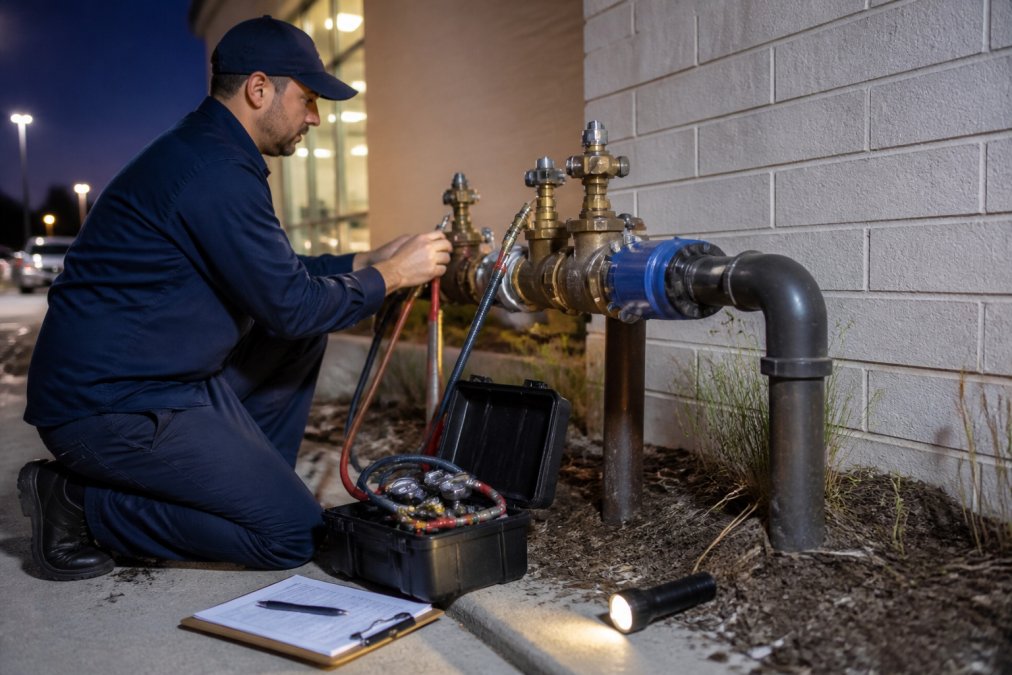
A backflow preventer testing procedure follows a defined sequence, and understanding it helps you plan around the water interruption. The test itself is usually quick, but the assembly must be isolated and its valves operated, so you'll want to schedule it when a brief shutdown won't disrupt occupants.
What Happens During the Test
The certified technician connects calibrated test equipment to the assembly's test ports and checks each function in order:
- Confirm the device type and note its location and serial number
- Isolate the assembly and attach the test kit to the designated ports
- Test the first check valve for tightness
- Test the second check valve, where the device has one
- Test the relief valve on an RPZ assembly
- Record all readings on the official test report
- Restore the assembly and verify normal water flow
Annual Backflow Certification Cost: What Affects Your Bill
Annual backflow certification cost is not a single number, and any provider who quotes one before seeing your assembly list is guessing. What you can control is knowing which variables move the price and how after-hours billing is structured, so the invoice matches the quote.
The factors that drive the total:
| Factor | Why It Changes the Cost |
|---|---|
| Number of assemblies | Each device adds test time; portfolios are often quoted per assembly with a volume break |
| Device type | A reduced pressure zone (RPZ) assembly takes longer than a double check valve because the relief valve must be tested separately |
| Site access | Locked vaults, roof-mounted lines, or assemblies behind finished walls add labor and sometimes a return trip |
| Scheduling window | Standard business hours, weeknight after-hours, and weekend/holiday windows are typically three different rates |
| Repairs needed | A failed device requires parts plus a re-test, which is billed separately from the original test |
| Reporting | Utilities that require portal submission or a specific form can add administrative time |
How After-Hours Billing Usually Works
Most providers structure after-hours pricing one of three ways, and it pays to know which one you're being quoted:
- Flat after-hours rate, one rate for any appointment outside standard hours, regardless of day. Simplest to budget.
- Tiered rate, a weeknight rate (typically a smaller premium) and a weekend/holiday rate (typically a larger premium). Common in markets with heavy commercial demand.
- Per-device surcharge, the after-hours premium is applied to each assembly tested, not to the visit. This is the structure that surprises property managers most, because a 10-device portfolio can multiply the premium tenfold.
Three Questions to Ask Before You Approve a Quote
- Is the after-hours premium a flat rate, a tiered rate, or a per-device surcharge?
- Does the premium apply per visit or per assembly?
- If a device fails, is the repair quoted and approved separately before any work begins?
For context on why the work matters, the CDC's drinking water safety resources outline the public health risks that backflow programs are designed to prevent.
After-Hours Surcharge Transparency: What You Should Know
After-hours surcharge transparency is where a lot of providers get vague, and that vagueness costs property managers money. The fair approach is simple: tell the customer up front what the after-hours rate is, what triggers it, and whether the weekend rate differs from the weeknight rate. No surprises on the invoice.
When you request a quote, ask three questions directly:
- Is there a separate night rate versus a weekend rate?
- Does the surcharge apply per visit or per device?
- If a repair is needed, is that quoted separately before work begins?
DIY vs. Professional Backflow Testing: Why Certification Matters
A certified technician carries the training, the calibrated test kit, and the credentials your municipality verifies. That's the difference between a valid certification and a worthless piece of paper.
Troubleshooting Common Backflow Test Failures
Most test failures trace back to a handful of causes, and knowing them helps you decide between a quick fix and a scheduled repair. The most frequent issues are a fouled or worn first check valve, debris lodged in the valve seat, a relief valve that opens at the wrong pressure, and a device that simply wasn't maintained between annual tests.
Frequently Asked Questions
What is a backflow test and how much does it cost?
A backflow test checks whether your backflow preventer stops contaminated water from reversing into the clean supply. Pricing depends on the device type, number of assemblies, and scheduling window. After-hours appointments may carry a surcharge. H-Town Backflow provides quotes based on your property's specific setup, so contact them for current pricing.
How long does it take to test a backflow device?
A standard test on a single backflow assembly takes 15 to 30 minutes for a certified technician. If your property has multiple devices, expect longer. After-hours testing is scheduled to minimize water service interruption, and most commercial systems can remain operational during the test.
Can I test my own backflow preventer?
No. Most municipalities require testing by a certified backflow tester, and the results must be submitted on official forms. DIY testing without certification won't satisfy plumbing code compliance and could leave you liable. Always hire a certified technician who can file the test report with your water utility.
What are the benefits of scheduling backflow testing outside of business hours?
After hours backflow testing services let you avoid shutting off water during peak business hours, which prevents tenant complaints and lost revenue. Night and weekend appointments also make it easier to meet annual inspection deadlines without disrupting operations. Flexible scheduling keeps your property compliant without downtime.