 blog
blog
Certified Backflow Testing Near Me: 2026 Guide
Table of Contents
- What Certified Backflow Testing Actually Involves
- How Often Is Backflow Testing Required?
- Backflow Prevention Assembly Testing Cost: What Drives the Price
- Hiring a Licensed Backflow Plumber: What to Verify
- Commercial vs. Residential Backflow Services
- Why DIY Backflow Testing and Certification Fall Short
- Frequently Asked Questions
Last Updated: September 23, 2026
What Certified Backflow Testing Actually Involves
Certified backflow testing is the annual inspection a licensed technician performs on a backflow prevention assembly to confirm it still stops contaminated water from reversing into the potable water supply. This guide walks through what the test covers and how to hire someone qualified. Most assemblies pass in under an hour. The consequences of skipping it are far more expensive than the test itself.
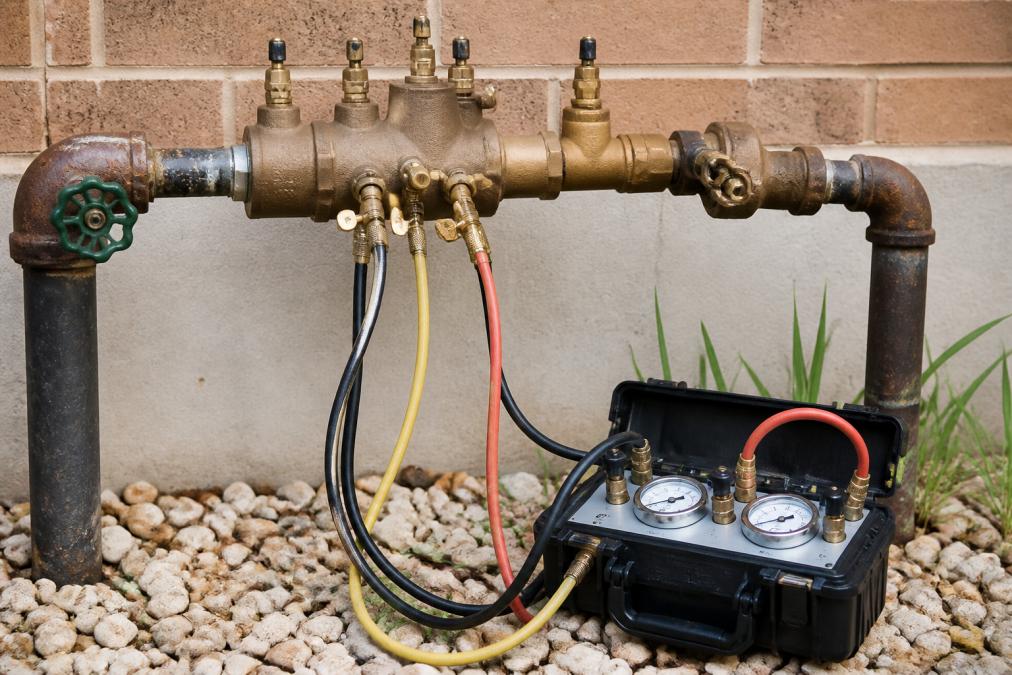
A backflow prevention assembly is a mechanical device installed on a water line that allows water to flow in one direction only. When pressure drops somewhere in the system, dirty water can get pulled backward through cross-connections. That reversal is called back-siphonage, and its opposite, back-pressure, happens when downstream pressure climbs above supply pressure.
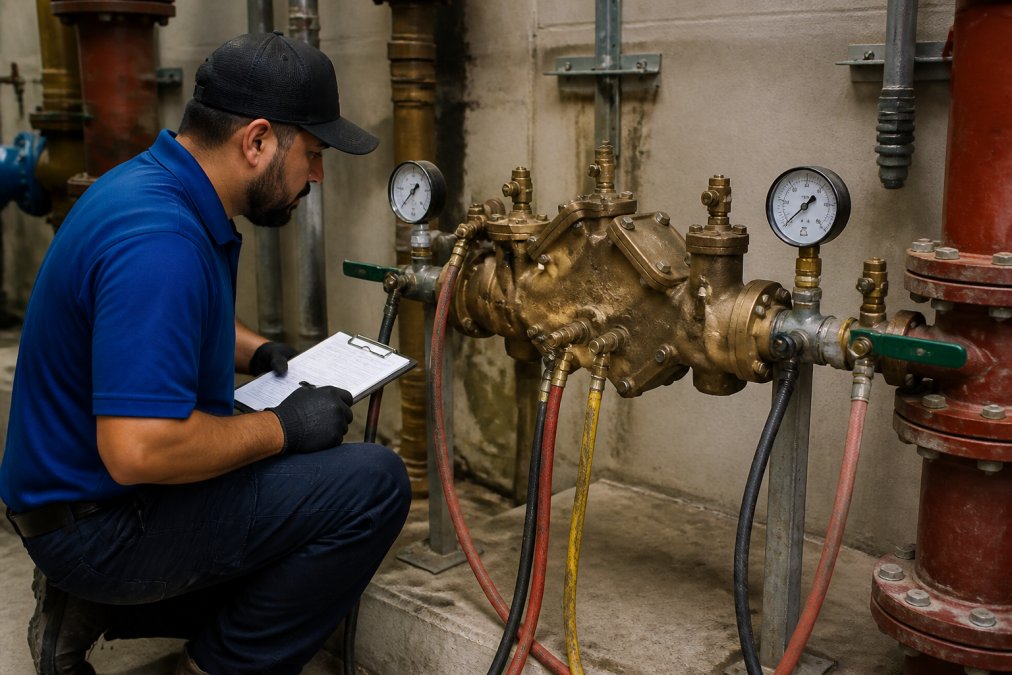
The Test Process, Step by Step
The technician shuts off the supply, attaches calibrated test gauges to the assembly's test cocks, and runs a sequence of pressure checks. Each check confirms a specific valve holds when it should. For an RPZ valve, that means verifying the relief valve opens at the right differential and both check valves seal. For a double check valve, it means confirming neither check leaks past its seat.
Results get recorded on a test report and submitted to the local water utility. In practice, that paperwork is where most violations happen, and it's the part property managers underestimate most. A failed reading means the device needs repair or replacement, followed by re-testing before the report can be filed.
Spotting the Signs of a Faulty Backflow Preventer
- Water discharging from the relief valve on an RPZ assembly
- Visible corrosion, mineral buildup, or leaking at the test cocks
- A pressure drop you can measure at nearby fixtures
- An assembly that hasn't been tested since the last compliance cycle
- Discolored water appearing after a main break or heavy irrigation use
How Often Is Backflow Testing Required?
Annual testing is the standard for most backflow prevention assemblies, though the exact schedule comes from your local plumbing code and water utility, not a single national rule. Some jurisdictions require testing every year, and high-hazard assemblies rarely qualify for longer intervals. Irrigation systems, fire sprinkler lines, and commercial boiler feeds all typically fall under annual inspection.
What trips people up is that the requirement attaches to the device, not the property. A small irrigation backflow preventer at a house carries the same annual obligation as a large commercial assembly. Utilities track devices by tag number, and a lapsed test shows up as a compliance violation tied to that tag.
Backflow Prevention Assembly Testing Cost: What Drives the Price
Pricing for backflow prevention assembly testing cost depends on the device type, its size, how accessible it is, and whether it needs repair. A single small assembly in an open mechanical room is a straightforward job. A large reduced pressure zone device tucked behind equipment, or one that fails and needs parts, takes longer and costs more.
The variables that move the price:
| Cost Factor | What Changes It | Typical Impact |
|---|---|---|
| Device type | RPZ vs. double check vs. vacuum breaker | RPZ costs more to test because it has more test points |
| Assembly size | Small irrigation line (½"-1") vs. large commercial main (2"-8"+) | Larger devices take longer and require larger test kits |
| Accessibility | Open room vs. confined or obstructed space | Hard-to-reach adds labor; confined-space entry adds more |
| Repair needed | Passing device vs. one needing parts | Failed test adds a return visit plus parts and re-test |
| Scheduling | Standard hours vs. after-hours | Off-hours carries a premium |
| Filing | Tester submits report vs. you submit it | Some providers charge a filing fee; others include it |
Two cost traps catch property owners. First, a failed test is not the same as a repair quote, you pay for the test, then pay again for the repair, then pay a third time for the re-test that certifies the fix. Second, the cheapest advertised test is often the most expensive overall if the provider doesn't file the report, because an unfiled passing test still counts as a compliance violation and can trigger a utility notice or service interruption.
Rather than quote a number that won't hold, H-Town Backflow prices each job after confirming the assembly type and location. For a current figure, request a quote directly.
Hiring a Licensed Backflow Plumber: What to Verify
Hiring a licensed backflow plumber means confirming three things before anyone touches your assembly: a valid state license or certification, current calibration on their test equipment, and the ability to file the test report with your water utility. Certification matters because an uncertified tester's report won't be accepted, which means you've paid for a test that doesn't count.
Ask for the technician's certification number and the license number of the company. A legitimate provider gives both without hesitation. You should also confirm who submits the report. Some testers hand you paperwork and leave the filing to you, which is exactly where busy property managers drop the ball.
Identify Your Device Before You Call
Getting an accurate quote starts with knowing what you have. Backflow assemblies are stamped or tagged with a model number, and the three you'll encounter most are:
- RPZ (Reduced Pressure Zone), the most common high-hazard assembly. It has a relief valve that discharges water when it senses a pressure problem. If you see a valve dripping or discharging, it's likely an RPZ.
- DCV (Double Check Valve), two check valves in series with no relief port. Common on fire sprinkler lines and lower-hazard commercial connections.
- PVB (Pressure Vacuum Breaker), typically found on irrigation systems. It has a single check and an air inlet that opens to atmosphere.
Look for a brass or bronze body with test cocks (small screw-cap ports) on top. The tag number stamped on the device is what your water utility tracks, so have it ready when you call, it lets the provider quote the right device instead of guessing.
How the Test Report Gets Filed
This is the step most guides skip, and it's where compliance records actually fail. After a passing test, the technician completes a test report form, often the utility's own form or a state-standard form, recording the device tag number, make, model, size, test gauge readings, and the tester's certification number. That report has to reach your water utility, usually within a set number of days after the test.
Filing typically happens one of three ways: the tester submits it electronically through the utility's portal, the tester mails or emails a signed copy, or the tester hands the form to you and you file it. The third option is the one that causes violations, because a passing device with an unfiled report still shows as non-compliant in the utility's system.
Before you hire, ask three questions: Do you file the report directly with my utility?
H-Town Backflow holds BP # 0024323 and files reports on your behalf, so the compliance trail stays complete.
Commercial vs. Residential Backflow Services
Commercial and residential backflow services differ mainly in device size, hazard level, and scheduling pressure. A commercial property may run multiple assemblies across fire, irrigation, and process water lines, each needing its own test and tag. A home typically has one assembly, often on the irrigation system.
Why DIY Backflow Testing and Certification Fall Short
DIY backflow testing fails for one simple reason: the report has to come from a certified tester, and certification requires training, calibrated gauges, and a state-recognized credential. You can't self-certify a device. A homeowner or facility manager can absolutely learn to spot a faulty assembly, but the test itself and the paperwork carry legal weight that only a certified technician can sign off on.
Frequently Asked Questions
What is a backflow test and why is it required?
A backflow test confirms that your backflow prevention assembly is stopping contaminated water from reversing into the potable water supply. Certified testers check the device's check valves, relief valve, and air ports under real pressure conditions. Testing is required because cross-connection control regulations and local plumbing codes mandate it, and your water utility can suspend service if the assembly fails inspection or goes untested.
How much does professional backflow testing cost?
Pricing depends on the assembly type, how many devices you have, and whether repairs are needed. H-Town Backflow does not publish flat rates because every site differs. Contact them directly for a quote based on your device count and location, and ask whether the fee covers test report submission to the city.
Can property owners perform their own backflow testing?
No. Most jurisdictions require testing by a certified tester or licensed plumber who carries the proper credentials and calibrated gauges. Even if you understand how a double check valve works, you cannot legally sign and submit the test report yourself without certification. Uncertified testing also leaves you exposed if contamination occurs, since your liability coverage may not apply to work performed outside licensing requirements.
What happens if a backflow test fails?
A failed inspection means the assembly is not protecting the water supply. The tester documents the failure and typically tags the device. Some repairs, like replacing a worn check valve or O-ring, can be done the same visit. Larger issues may require parts ordering and a return trip. Your water utility sets a deadline for re-testing, and ignoring it can lead to enforcement action or service interruption.