 blog
7 Backflow Testing Service Tips for Property Managers
Last Updated: November 1, 2026
Quick Summary
A backflow testing service for property managers is the scheduled inspection that confirms every backflow preventer on a property still stops contaminated water from reversing into the potable water supply. Most jurisdictions require annual testing by a certified tester, with results filed to the local water authority.
- Only a tester with current certification recognized by the local water authority can perform and file the test.
- Keep one register row per backflow assembly, recording make, model, serial number, location, and governing authority.
- Work backward at least 60 days from each due date so a failed test leaves room for repair and retest.
- A failed device must be repaired or replaced and retested, usually within a deadline set by the authority.
- Verify the tester's certification number directly before booking, not after.
Table of Contents
- Why Backflow Testing Matters for Every Property You Manage
- Backflow Testing Requirements: What Property Managers Must Know
- The Backflow Testing Checklist for Property Managers
- Backflow Testing Scheduling Across a Multi-Property Portfolio
- What Belongs in a Backflow Test Report
- Failed Tests, Repairs, and What Happens Next
- Choosing a Certified Backflow Tester for Your Properties
- Booking Backflow Testing for Your Houston Portfolio
- Frequently Asked Questions
Why Backflow Testing Matters for Every Property You Manage
Here is the core tension. Backflow prevention is invisible when it works. A failed device does not announce itself.
Backflow is the unwanted reversal of water flow in a piping system, caused by pressure changes that pull non-potable water backward through a cross-connection.
Skipping a test because the device "looks fine" is a mistake to avoid, since a backflow assembly can look sound on the outside and still fail on the inside.
Backflow Testing Requirements: What Property Managers Must Know
Most jurisdictions require annual testing of backflow prevention assemblies by a certified tester, with results filed to the local water authority. Requirements vary by municipality, so confirm the specifics with the authority that governs each address.
The practical points managers need to track:
- Who may test. Only a tester holding current certification recognized by the local water authority can perform and file the test.
- How often. Annual testing is the standard baseline, though some device types or local rules require more frequent checks.
- What gets filed. A test report goes to the water authority, and the property should retain a copy.
Because rules differ from one municipality to the next, a portfolio spanning several cities needs a compliance matrix, not a single blanket assumption. The U.S. Environmental Protection Agency's cross-connection control guidance explains why backflow prevention sits at the center of drinking water safety.
Here are the core compliance points managers need to track for each address.
| Item | Requirement | Note |
|---|---|---|
| Who may test | Only a tester with current certification recognized by the local water authority | Verify before booking |
| How often | Annual testing is the standard baseline | Some device types or local rules require more frequent checks |
| What gets filed | A test report goes to the water authority | The property should retain a copy |
| What happens on failure | Device must be repaired or replaced and retested | Usually within a deadline set by the authority |
| Rules across municipalities | Requirements vary by municipality | A multi-city portfolio needs a compliance matrix |
The Backflow Testing Checklist for Property Managers
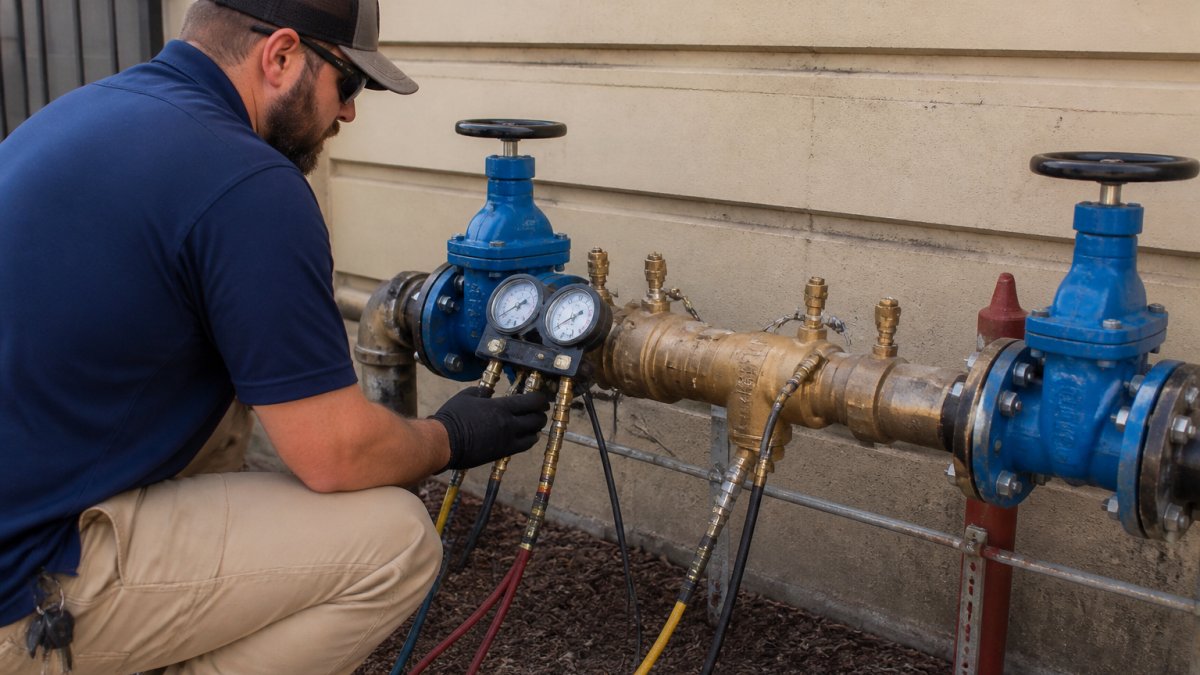
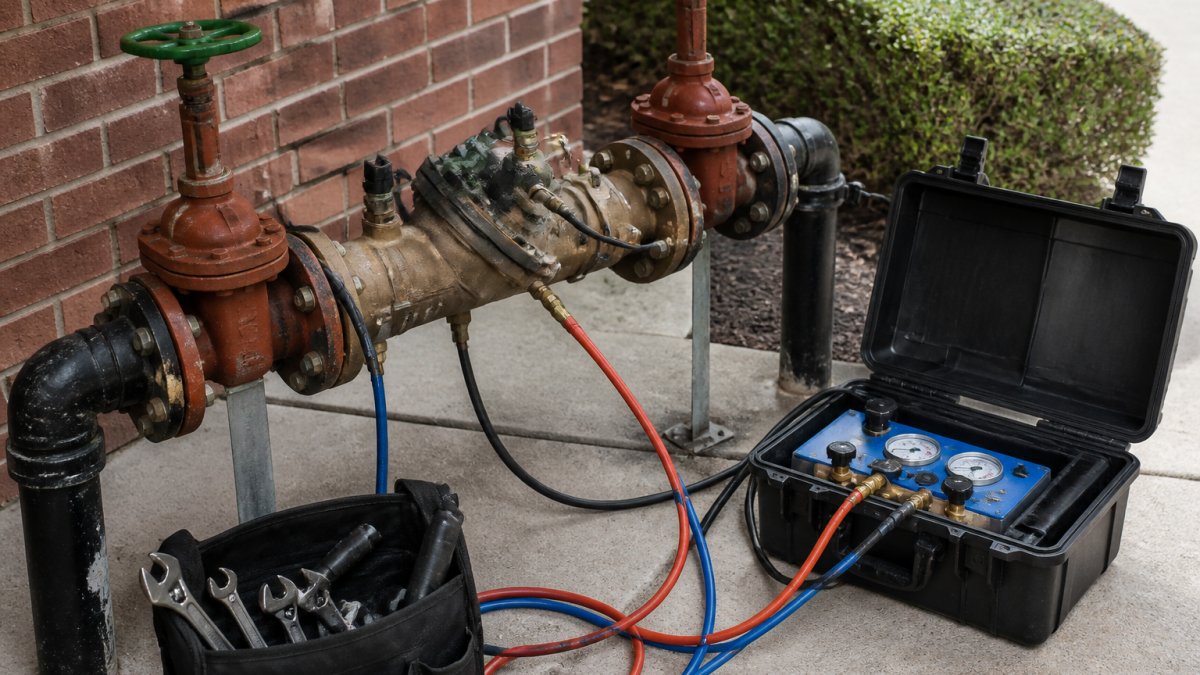
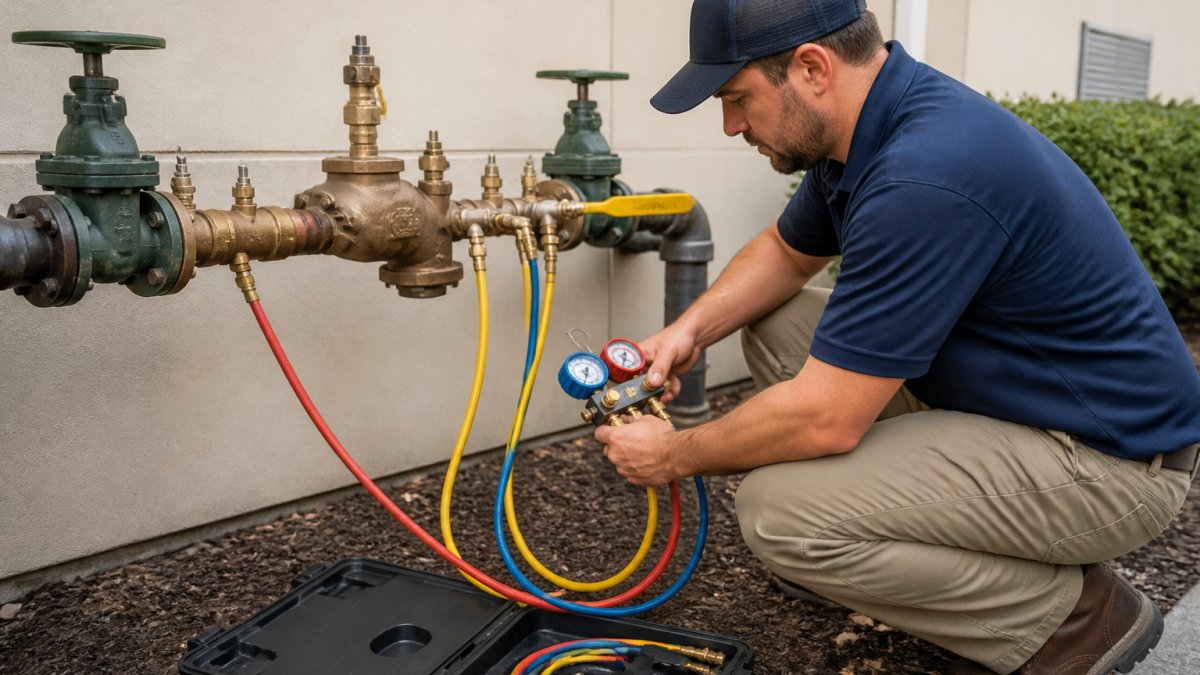
A backflow testing checklist for property managers should cover three phases: preparation before the tester arrives, observation during the test, and record-keeping afterward. The list below is the one we would hand any manager running a portfolio.
Before the Tester Arrives
- Confirm the device location and access for each assembly
- Clear obstructions around the device and shut-off valves
- Notify tenants of any brief water interruption
During and After the Test
- Confirm the tester records the device make, model, and serial number
- Ask for the test readings and pass/fail result
- Obtain a copy of the completed test report
A step-by-step walkthrough of the inspection itself is useful if you have never observed one: what happens during a backflow inspection covers each stage in order.
Backflow Testing Scheduling Across a Multi-Property Portfolio
Scheduling is where portfolios quietly fall apart. A single building is easy to book. Twenty buildings across five water authorities, each with its own deadline and access quirks, is a logistics problem.

The workable system has four moving parts:
- A device register. One row per backflow assembly, not one row per building. A single property can carry an irrigation assembly, a fire-line assembly, and a domestic-line assembly, each with its own test date and filing requirement. Record the make, model, serial number, location on site, and the water authority that governs the address.
- A due-date calendar keyed to the authority, not the calendar year. Test cycles are usually annual, but the anniversary date is set by the last filed test, and some authorities set a fixed window. Sort the register by due date and work backward at least 60 days so a failed test still leaves room for repair and retest before the deadline.
- An access plan per address. Note who holds the keys, whether the device sits in a locked mechanical room, whether a tenant must be present, and whether the assembly needs the water shut off to test. Access failures are the most common reason a booked visit turns into a wasted trip and a rescheduled deadline.
- A tenant notification template. Water interruptions are the objection managers hear most. A short written notice, date, window, which fixtures or suites lose water, and who to call, prevents the front-desk confusion that turns a routine test into a complaint.
Batching by Geography and Deadline
Group properties by water authority first, then by due date within each group, and book the earliest-due buildings first.
A practical pattern many managers adopt is a rolling schedule: test roughly one-quarter of the portfolio each quarter, weighted toward the authorities with the shortest grace periods after a failed test. That spreads the cost across the budget year and avoids a December scramble when every due date lands at once.
After-Hours and Weekend Appointments
For retail, food-service, and office tenants, a daytime water shutoff means lost business. After-hours and weekend testing moves the interruption outside operating hours, but it changes the scheduling math: you need a building contact who can grant access at night, a tester who will file the report the next business day, and a clear understanding of whether the authority accepts a test performed outside normal hours (most do, because the test is about the device, not the clock).
Managers weighing off-hours scheduling should understand how it works before booking: after hours backflow testing services explains what to expect from arrival to filed report.
What Belongs in a Backflow Test Report
A backflow test report is the formal record of the inspection, and it should contain the device identification, the test readings, the pass or fail result, the tester's certification details, and the date.
What most managers miss is the value of the report as a portfolio asset. A single filed report protects one building.
Keep three things for every test:
- The filed report as submitted to the authority
- The tester's certification number and expiration
- The next due date, logged where you will actually see it
Digital records are easier to organize here. A shared folder organized by address and year makes an audit faster to answer.
Failed Tests, Repairs, and What Happens Next
A failed test is not a disaster, but it is a deadline with a clock attached. When an assembly fails, the device must be repaired or replaced and retested, and the water authority typically sets the window for doing so. The faster you act, the less risk of a compliance notice, and, depending on the authority, the less risk of a shutoff notice or a penalty on the account.
The failure response has five stages, and each one has a decision the property manager owns:
- Notification and documentation. The tester records the failure on the test report and files it. Get the report the same day, note the specific test that failed (for example, a check-valve hold or a relief-valve opening), and log the authority's retest deadline in the device register.
- Diagnosis. Common causes include worn seals and rubber components, debris lodged in the assembly, freeze damage, and simple age. The diagnosis determines whether this is a repair or a replacement, and that determines the budget line.
- Repair authorization. Decide in advance who can approve a repair and up to what amount. A portfolio with a standing authorization threshold avoids the days lost to email chains while a deadline runs.
- Temporary risk controls. If the device cannot be repaired immediately, ask the tester and the water authority what interim measures are acceptable, often isolating the cross-connection or restricting use of the affected system, until the retest passes. Do not assume; confirm what the authority will accept in writing.
- Retest and close-out. The repaired or replaced assembly must be retested and the passing report filed. Close the loop in the register only when you hold the filed passing report, not when the repair invoice arrives.
Turnaround Expectations
Can it be fixed same-day? Sometimes. Minor repairs, a replaced seal, a cleared obstruction, and the retest can often be handled in one visit. Replacement parts for less common assemblies and full device swaps may require a second trip, and specialty devices can carry lead times. A realistic planning assumption is one visit to diagnose and repair and a second to retest, with same-day close-out as the bonus case rather than the baseline.
What to Keep After a Failure
A failed-then-passed device generates a paper trail that matters at audit. Keep the original failed report, the repair record or invoice, the passing retest report as filed, and a note of the authority's deadline and the date you met it.
A guide to common reasons backflow tests fail covers the usual culprits and what each one implies for repair versus replacement.
Choosing a Certified Backflow Tester for Your Properties
Certification is the non-negotiable. A tester must hold current certification recognized by the local water authority, and you should verify it before booking, not after.
Beyond certification, judge a tester on three things:
- Scheduling flexibility. Can they work around tenant hours?
- Reporting. Do they file with the authority and give you a copy?
- Repair capability. Can they fix what they find, or do you need a second vendor?
Vetting credentials takes more than a phone call. Practical guidance on verifying backflow technician credentials walks through the checks worth making.
H-Town Backflow offers flexible scheduling, including night and weekend appointments, to keep operations running without a water service interruption, and serves the City of Houston and surrounding municipalities.
Booking Backflow Testing for Your Houston Portfolio
Booking starts with knowing your deadlines. Pull the due dates for every address, group them by municipality, and book the earliest first.
For managers ready to schedule, a local guide to finding certified backflow testing near me narrows the search to providers who actually serve your addresses.
A few practical notes before you book:
- Confirm which authority governs each address
- Check whether the device needs clear access for the test
- Ask how the report gets filed and who receives the copy
Managing backflow compliance across a portfolio should not mean chasing deadlines building by building.
Frequently Asked Questions
How often does a backflow preventer need to be tested?
Most water authorities require annual testing of backflow prevention assemblies, and the test date is tied to the device's compliance cycle rather than the calendar year. Some jurisdictions set different intervals for certain device types, so confirm the schedule with your local water authority. For a portfolio, track each device's due date individually and book backflow testing before the deadline, since a lapsed test can trigger notices or service penalties.
Who is responsible for scheduling backflow testing at a commercial property?
The property owner or manager is typically responsible for arranging backflow testing and keeping the device in compliance, even when a tenant operates the building. Put the obligation in writing in leases and vendor contracts so accountability is clear. A recurring backflow testing scheduling process, with a named contact for each site, prevents devices from slipping through when staff turn over.
Can backflow testing be scheduled outside business hours?
Yes. Many providers, including H-Town Backflow, offer night and weekend appointments so testing does not interrupt tenants or operations. After-hours slots are useful for retail, restaurants, and multi-unit buildings where a water shutdown during the day is disruptive. Ask about after-hours availability and any scheduling constraints when you request a quote, and confirm the arrival window in writing.
What records should property managers keep after a backflow test?
Keep the completed backflow test report, the tester's certification details, the device make, model and serial number, and the date of the next required test. Store copies digitally so they are ready for an audit or a water authority request. Consolidated reporting across a portfolio makes it easy to see which devices passed, which need repair, and which are approaching their next deadline.