 how-to
How to Verify Backflow Technician Credentials
Table of Contents
- Start With the Basics: What a Backflow Technician Credentials Check Should Cover
- Backflow Tester Certification Requirements: What a Legitimate Credential Looks Like
- How to Run a Backflow Testing Certification Lookup with the Issuing Authority
- Check the Local Approved Tester List Before You Book
- Questions to Ask a Backflow Testing Company Before Hiring
- Backflow Testing Report Requirements: What You Should Receive After the Test
- Red Flags: Credential Fraud and What to Watch For
- Conclusion: Build a Simple Verification Habit
- Frequently Asked Questions
Last Updated: October 7, 2026
Start With the Basics: What a Backflow Technician Credentials Check Should Cover
Verifying backflow technician credentials means confirming four things: the person holds a valid certification, that certification is current, the technician is approved by your local water authority, and the paperwork matches the person standing in front of you.
That mistake is expensive. An unapproved test can be rejected, which means you pay twice and risk a compliance notice.
A backflow prevention assembly is the device that stops contaminated water from flowing backward into the clean supply. Only a qualified tester should touch it. So the check you run is not just about skill.
Certification Is Not the Same as Local Approval
A certification proves the technician passed a training program and an exam. Local approval proves your specific water authority will accept that person's test results.
These are two separate things, and many property managers treat them as one. A tester can be fully certified and still not approved in your municipality. Always confirm both.
Backflow Tester Certification Requirements: What a Legitimate Credential Looks Like
Backflow tester certification requirements vary by state, but most programs share a common core.
The U.S. Environmental Protection Agency's cross-connection control guidance treats backflow prevention as a public health matter, which is why states and local utilities set their own rules on top of it.
Most credentials follow a national standard for tester competence. That standard covers how to test each assembly type, how to inspect internal components, and how to file a correct report.
The Four Pieces of Information Every Certificate Should Show
A real certificate is not just a card. Look for these four items:
- Certificate number you can look up
- Certifying authority that issued it
- Expiration date that has not passed
If any of these are missing or unreadable, stop. Ask for a replacement document before you book.
How to Run a Backflow Testing Certification Lookup with the Issuing Authority
A backflow testing certification lookup is the fastest way to confirm a credential is real. You take the certificate number and the tester's name, then check them against the records held by the certifying authority.
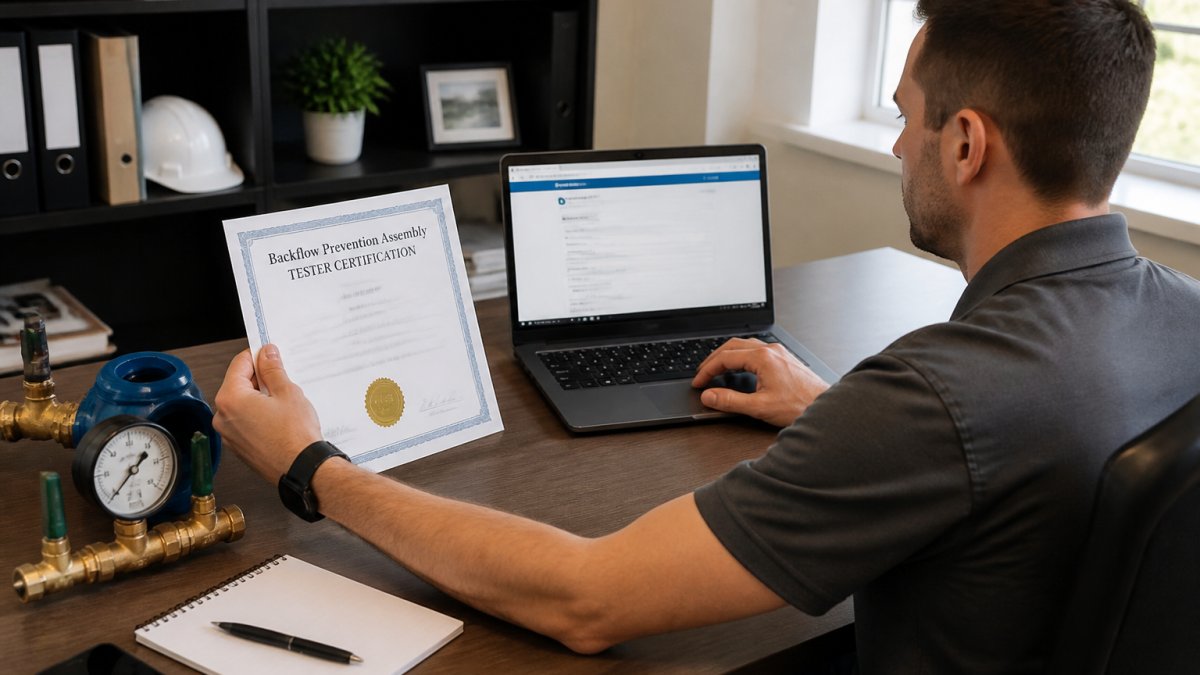
Identify Which Authority Issued the Credential
Backflow tester credentials in the United States typically come from one of three sources:
- A national certifying body that administers a standardized tester exam and maintains a searchable roster of certified individuals.
- A state drinking water or environmental agency that runs its own certification program and publishes a licensee database.
- A training provider whose certificate is recognized only if the state or local utility accepts that provider's curriculum.
Ask the technician which of these issued the certificate. The answer tells you where to look. A certificate from a training provider alone is the weakest form, it may satisfy a course requirement but not a state license or a local approval.
Where to Search, and What Each Search Returns
Start with the body named on the certificate, not a third-party directory. Directories aggregate stale data and are not authoritative.
- National certifying bodies usually publish an online "verify a certification" tool. You enter the certificate number or the tester's name and get back status, issue date, expiration date, and the assembly types the person is qualified to test.
- State agencies often maintain a licensee lookup through their drinking water or environmental health division. Some publish a downloadable roster updated on a set cycle; others offer a searchable database. A few still require a phone call or a written records request.
- Local utilities may not track certification at all, they track approval, which is a separate list covered in the next section.
If the authority has no online tool, call the office and ask for the certification status of a specific individual by name and certificate number. Request the answer in writing if you need a record.
Step-by-Step: Verifying a Certificate Number
- Ask the technician for their certificate number, the issuing authority, and the expiration date, in writing, before scheduling.
- Go to that authority's official website or call their office. Do not use a search engine result that points to a directory.
- Enter the certificate number and confirm the name on file matches the technician exactly. Watch for middle initials, suffixes, and name changes.
- Check the certification status, active, expired, suspended, or revoked, and the expiration date.
- Confirm the assembly types on file (for example, reduced pressure zone, double check, pressure vacuum breaker) match the device at your property.
- Note the scope: some credentials cover testing only, others cover testing and repair.
- Save a screenshot or a dated note of the result, including the URL or the name of the person you spoke with.
That last step matters. If a dispute ever comes up, you have a record of what you checked and when.
What a Lookup Cannot Tell You
A clean lookup confirms the credential is real and current. It does not confirm the technician is approved by your local water authority, does not confirm insurance or bonding, and does not confirm the person who shows up is the person named on the certificate. Pair the lookup with the local approval check and a photo ID match on site.
Check the Local Approved Tester List Before You Book
Your local utility or city keeps an approved tester list, and this is the list that actually governs your job.
Call the water department or check their website. Confirm the tester's name appears, and confirm the approval is current.
This is where general certification and jurisdiction-specific approval split apart. The state says the person is qualified. Your city says whether they can file here.
Questions to Ask a Backflow Testing Company Before Hiring
The right questions to ask a backflow testing company cover credentials, scheduling, and paperwork. Ask them up front and you avoid most problems later.
- Who will actually perform the test, and what is their certificate number?
- Are you approved by my specific water authority?
- What happens if the assembly fails the test?
That last question separates a testing-only outfit from one that can also handle repairs.
For commercial sites and multi-unit properties, downtime is the real cost. Ask how long the test takes and whether water service is interrupted.
Backflow Testing Report Requirements: What You Should Receive After the Test
Backflow testing report requirements are set by your local authority, but a complete report almost always includes the same core fields. You should receive a copy, not just the city. The report is also your best evidence that the technician who showed up is the one whose credentials you verified.
The Core Fields Every Report Should Contain
A proper report shows the assembly location, make, model, size, and serial number. It records the test results for each check, for a reduced pressure zone assembly, that means the differential pressure readings across the first and second check valves and the relief valve; for a double check assembly, the two check valve readings.
If any field is blank, the report is incomplete and may be rejected by the authority. Ask for a corrected copy before the filing deadline.
Who Files the Report, and How You Confirm It Was Filed
Filing responsibility varies by jurisdiction. In some cities the tester files directly with the water department or a third-party compliance portal. In others the property owner is responsible for submitting the report.
When the tester files, ask for proof of submission. That is usually one of the following:
- A confirmation number or tracking ID from the authority's online portal
- A stamped or dated receipt from the water department
- A copy of the filed report with the authority's received stamp
A verbal "we filed it" is not confirmation. If the authority does not send an acknowledgment to the property owner, ask the tester to forward theirs.
Documents to Request After Every Test
Ask for these documents after testing and keep them together in one file per assembly:
- A copy of the completed test report, signed by the tester
- The tester's name and certificate number on the form, matching the credential you verified
- Confirmation that the report was filed with the authority, with a confirmation number or stamp
How Long to Keep Records
Most jurisdictions require the property owner to retain test reports for a set period, commonly several years, and sometimes for the life of the assembly. Even where no retention rule applies, keep reports for at least the full interval between tests plus one cycle. When an assembly is replaced, keep the old reports with the new assembly's file so the compliance history stays intact.
Using the Report to Catch Credential Problems
Compare the tester name and certificate number on the report against the credential you verified before the job. If they do not match, the person who performed the test may not be the person you cleared. That is a red flag worth a call to the authority. A mismatched name is one of the most common signs of an unapproved tester using someone else's credentials.
Red Flags: Credential Fraud and What to Watch For
Credential fraud in this trade is usually quiet, not dramatic. The most common sign is a technician who dodges the certificate number question or gives a number that does not match any record.
Watch for these:
- No certificate number, or a number that fails a lookup
- An expired certification presented as current
- A tester not on your local approved list
One more red flag: a tester who claims approval in every city. Approval is granted one jurisdiction at a time. Broad claims deserve a quick check.
Conclusion: Build a Simple Verification Habit
Verifying backflow technician credentials takes about ten minutes, and it protects you from rejected reports, repeat fees, and compliance trouble.
H-Town Backflow provides prompt and reliable backflow testing and repair services to ensure your water supply remains safe and free from contaminants. Serving the Greater Houston area and surrounding municipalities, our experienced team helps keep your systems compliant and operating safely.
Get started with H-Town Backflow and keep your system compliant without the guesswork.
Frequently Asked Questions
How can I verify a backflow technician's certification?
Ask the technician for their certificate number, the name of the certifying organization, and the expiration date. Then contact that organization directly by phone or through its website to confirm the certification is active. You can also check with your local water utility or municipal cross-connection control office to see whether the technician appears on the approved tester list for your jurisdiction.
What credentials should a backflow tester have?
A qualified backflow tester should hold a current certification from a recognized certifying authority, carry a state or local license where required, and appear on your local utility's approved tester list. Their certificate should show a certificate number, expiration date, and the specific assembly types they are approved to test. Ask for proof of continuing education or renewal if the certificate is more than a year old.
How often must backflow preventers be tested?
Most jurisdictions require annual testing of backflow prevention assemblies, though some high-hazard connections may need testing more frequently. Your local water utility or cross-connection control program sets the exact schedule. After each test, the technician submits a test report to the utility, and you should keep a copy for your records to show compliance during inspections.
What should I ask a backflow technician before hiring them?
Ask for their certificate number and expiration date, whether they are on your local utility's approved tester list, what assembly types they are certified to test, and whether they handle the compliance paperwork and report submission. Also confirm their availability for after-hours or weekend appointments if you need to avoid water service interruptions, and ask what happens if a repair is needed during the same visit.