 how-to
Why Annual Backflow Testing Is Mandatory: 2026 Guide
Table of Contents
- Why Annual Backflow Testing Is Mandatory
- Annual Backflow Testing Requirements: Who Must Test and How Often
- What Happens If You Don't Get a Backflow Test
- Backflow Test Duration: What to Expect During the Visit
- Failed Tests, Repairs, and Retesting
- How to File a Backflow Testing Extension Request
- A Practical Compliance Checklist for Property Owners
- Step 1: Inventory Every Testable Assembly
- Step 2: Confirm the Deadline and Reporting Rules
- Step 3: Book a Certified Tester Early
- Step 4: Clear Access to Each Device
- Step 5: Confirm the Report Was Filed
- Step 6: Repair and Retest Any Failure Before the Deadline
- Step 7: File an Extension Request Only If You Must
- Records to Keep
- Conclusion
- Frequently Asked Questions
Last Updated: October 17, 2026
Why Annual Backflow Testing Is Mandatory
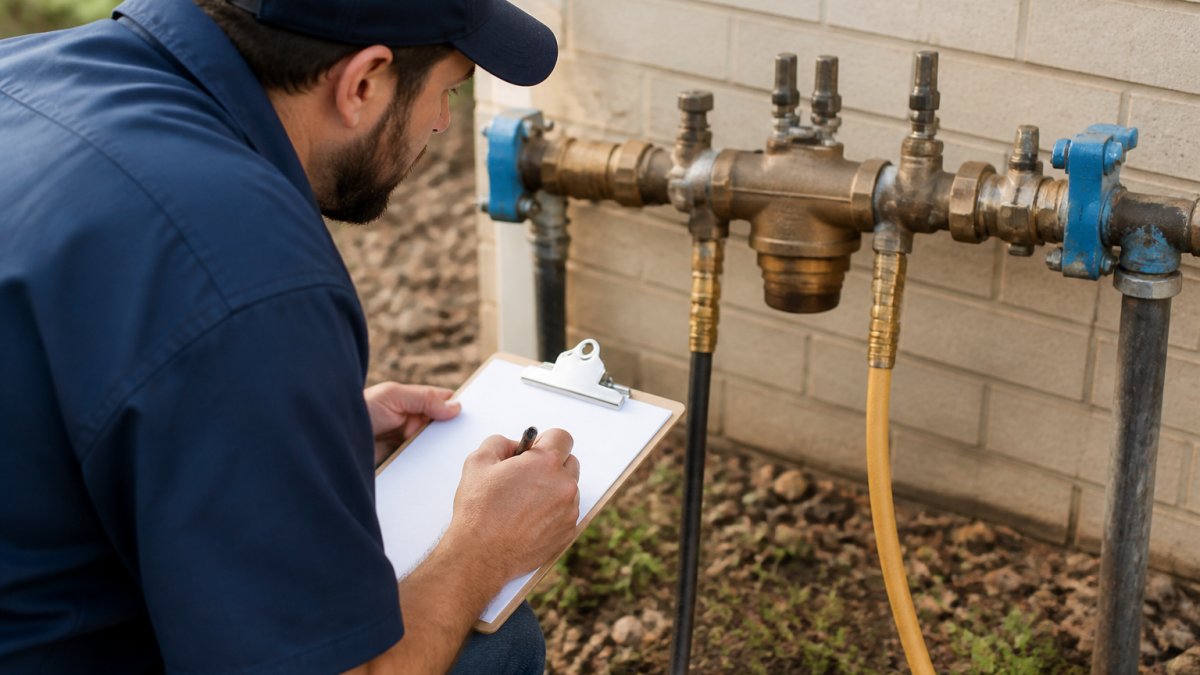
Annual backflow testing is mandatory because it is the only way to prove a backflow prevention device still works.
At H-Town Backflow, we see the same pattern each year: owners know a test is due but not why it matters, so they wait for the notice.
A backflow assembly has rubber seals, springs, and check valves that wear out.
Below: what triggers the requirement, what a visit looks like, and how to stay compliant without losing water service.
How Backflow Happens and Why It Threatens Drinking Water
Backflow is the reverse flow of water through a pipe, moving contaminated water toward the clean supply. It happens two ways.
- Backpressure pushes water backward when downstream pressure rises above supply pressure.
- Backsiphonage pulls water backward when supply pressure drops, such as during a main break or heavy firefighting demand.
Both create a cross-connection risk, any link between clean water and a possible contamination source, such as an irrigation line, boiler, pool fill line, or chemical dispenser.
The danger is real: a single reversed flow event can pull fertilizers, cleaning chemicals, or bacteria into the potable water lines serving an entire block.
Annual Backflow Testing Requirements: Who Must Test and How Often
Annual backflow testing requirements apply to any property with a testable assembly connected to the public water supply.
The rule is simple: if your device is testable, it gets tested. A testable assembly has test cocks that let a certified tester measure whether each check valve holds. A device without test cocks, such as a simple atmospheric vacuum breaker on a hose bib, generally cannot be performance-tested and is managed through inspection and maintenance instead.
Why the Frequency Is Usually Annual
Most cross-connection control programs set a 12-month cycle because internal parts wear predictably: rubber seals harden, springs lose tension, and check valves foul with scale or debris.
Some programs use a different cycle for certain devices or hazard levels. Reduced-pressure principle assemblies serving high-hazard connections are most commonly required to test annually, while some lower-hazard devices may be on a different schedule.
How to Verify the Exact Rule for Your Address
This is the step most property owners skip, and it causes the most missed deadlines. The requirement is tied to your service address and specific assembly. Here is how to pin it down:
- Find your water utility's cross-connection control page. Most utilities publish their program rules, the testing frequency, and the report form on their website.
- Look up your assembly by number. Utilities track every testable assembly by a serial or assembly number tied to the service address. That record tells you the device type and the required test interval.
- Check the approved tester list. Most utilities require the test to be performed by a tester who holds the state or local certification the utility recognizes, and many publish a list of approved providers.
- Confirm the reporting method. Some utilities require the tester to submit the report directly through an online portal; others accept a signed form by email or mail. The method matters because a test that is not reported correctly can still leave you out of compliance.
- Note the deadline and any grace period. Deadlines are often tied to the anniversary of the last passing test or to a fixed date set by the utility. Ask whether there is a grace period before penalties begin.
If the website is unclear, call the cross-connection control office and ask three questions: what is my device's required test interval, who is authorized to test it, and how must the report be filed. Get the answers in writing.
Who Is Responsible for Arranging the Test
The property owner or account holder is generally responsible for arranging and paying for the test, even when a tenant occupies the space. Commercial leases sometimes shift this to the tenant, but the utility usually holds the account holder accountable. If you manage multiple sites, confirm in writing who books the tester and who receives the report.
Which Properties and Systems Require a Testable Assembly
Common triggers include:
- Irrigation systems and lawn sprinkler lines
- Fire sprinkler systems with chemical additives or auxiliary supply
- Pools and spas with fill lines
If unsure, check your utility's rules or ask a licensed provider. A missed deadline almost always costs more than the test itself.
What Happens If You Don't Get a Backflow Test
What happens if you don't get a backflow test? Penalties escalate, and the last step is losing water service.
Most utilities follow a sequence: a reminder notice, then a second notice, then a possible fine.
That last step matters most for commercial property. Losing water shuts down restrooms, kitchens, cooling systems, and fire protection.
Backflow Test Duration: What to Expect During the Visit
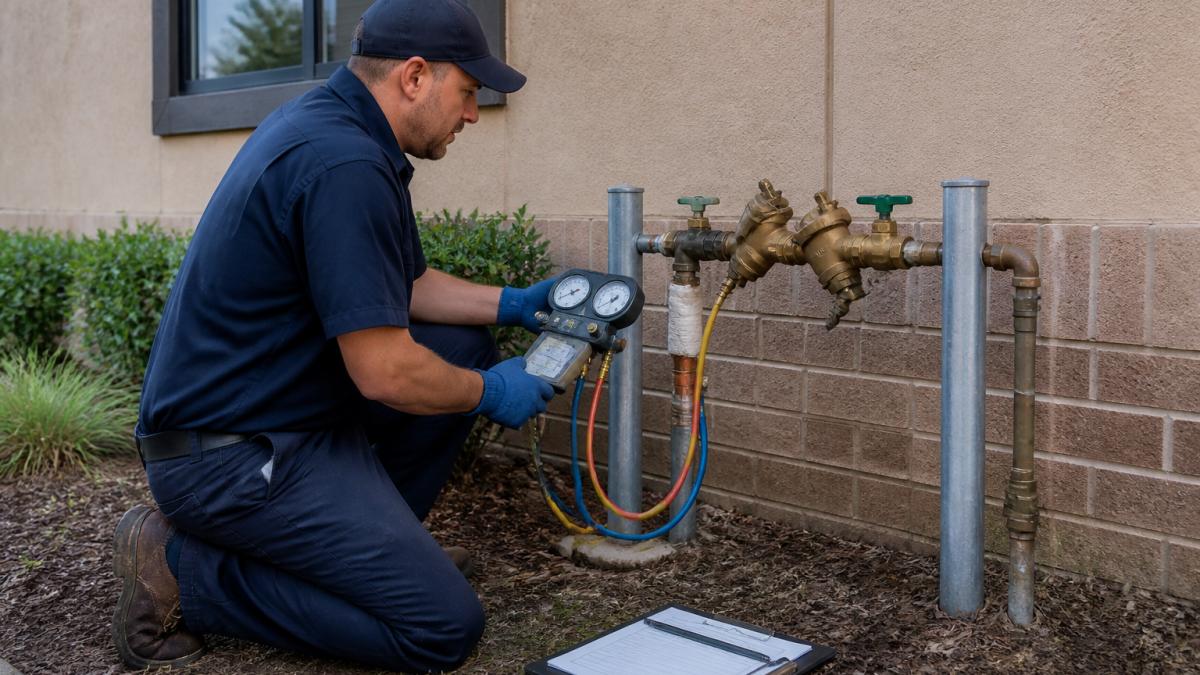
Backflow test duration is short: a single assembly usually takes about 15 to 30 minutes, assuming the device is accessible and working.
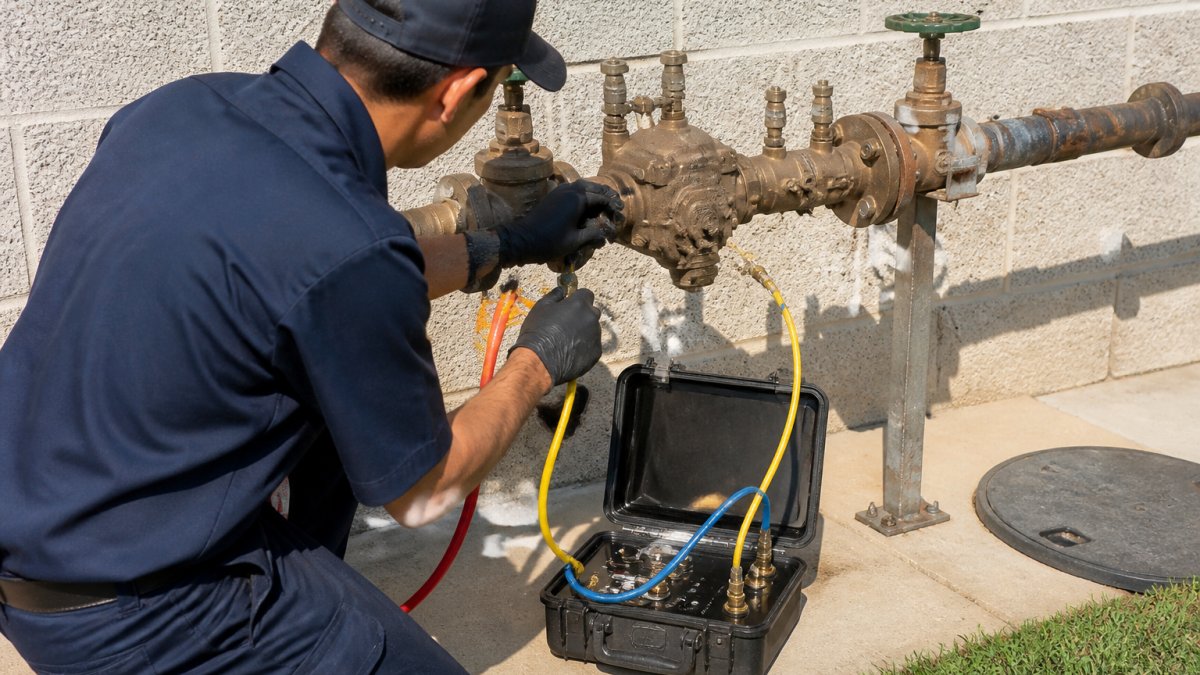
Here is what the visit looks like:
- The tester confirms the assembly number matches the utility record.
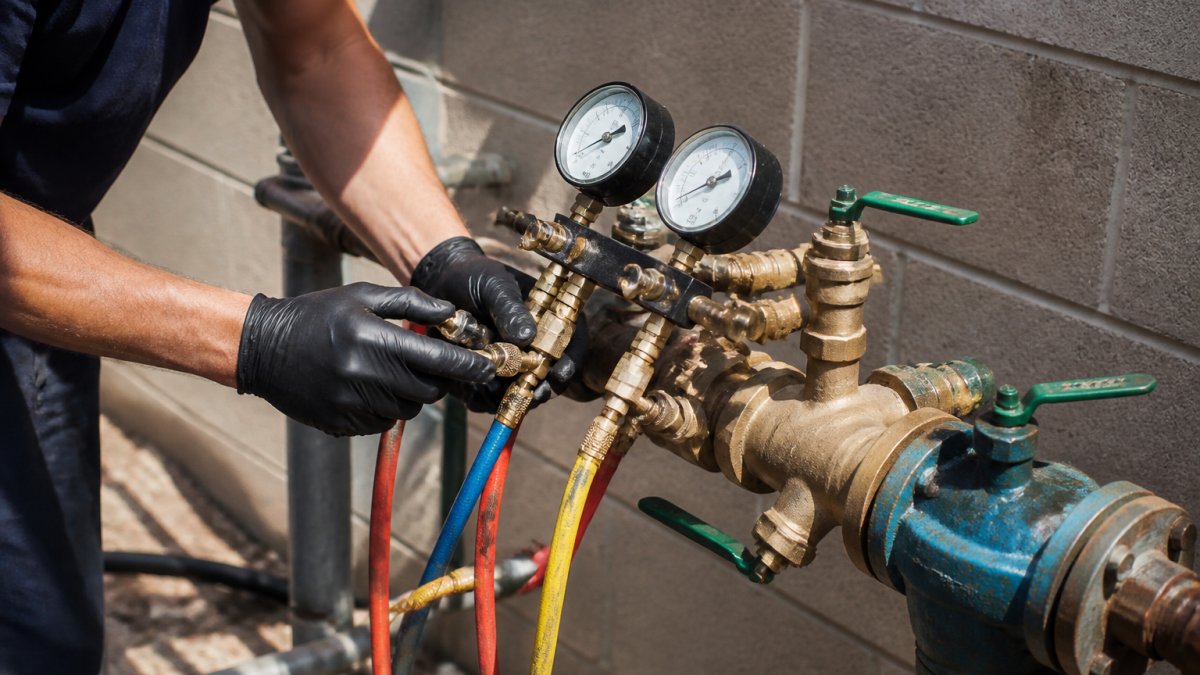
- They attach a calibrated gauge to the test cocks.
- They check each check valve for a hold.
- They record readings on the test form.
- They submit the report to the water authority.
Your water stays on during the test in most cases. Brief pressure changes are normal. For a building with several assemblies, plan for a longer window.
Failed Tests, Repairs, and Retesting
A failed test means at least one check valve did not hold. That does not always mean the device is junk.
The process after a failure:
- The tester documents the failure on the report.
- A repair is scheduled, either same-day or on a follow-up visit.
- The device is retested after repair.
Sometimes replacement is the better call. Older devices with discontinued parts cost more to keep alive than to swap out.
Ask your provider upfront whether they can repair and retest in one trip. It saves a second scheduling headache.
How to File a Backflow Testing Extension Request
A backflow testing extension request asks the water utility for more time to complete the test. Approval is not automatic, and rules vary by utility.
A common approach is:
- Contact the utility before the deadline, not after.
- Provide the assembly number and service address.
- Explain the reason, such as a scheduled repair or access issue.
Keep the approval in writing. If a fine shows up later, that document is your proof.
A Practical Compliance Checklist for Property Owners
The sequence below follows how cross-connection control programs actually work: the utility tracks an assembly by address, a certified tester performs and reports the test, and the account stays in good standing only when a passing report is on file before the deadline.
Step 1: Inventory Every Testable Assembly
Walk the property and list every device with test cocks: mechanical rooms, irrigation risers, fire protection connections, pool fill lines, and any boiler or chemical injection setup. Record the assembly number, device type, location, and utility account, and update it whenever a device is added, replaced, or removed, an incomplete inventory is the most common reason a device is discovered only after a notice arrives.
Step 2: Confirm the Deadline and Reporting Rules
Pull your utility's cross-connection control page and confirm the required test interval for each device type, the exact due date, the approved-tester requirement, and how the report must be filed. Deadlines are often tied to the anniversary of the last passing test, so put the date on a shared calendar with a reminder several weeks ahead.
Step 3: Book a Certified Tester Early
Schedule the test three to four weeks before the deadline. Spring and early summer are the busiest windows for irrigation and pool devices, and approved testers book up. Confirm the tester holds the certification your utility recognizes and will file the report directly, and ask whether they can repair and retest in a single trip.
Step 4: Clear Access to Each Device
Access problems are the leading cause of rescheduled visits. Before the tester arrives, clear landscaping, unlock vaults and access panels, and make sure the assembly is reachable without moving equipment. If a device is in a tenant space, coordinate access in advance, a rescheduled visit can push you past the deadline.
Step 5: Confirm the Report Was Filed
A test is not complete until the report reaches the utility. Ask the tester when they will submit it and confirm a week later that the utility has it on record. If the utility uses an online portal, ask for the confirmation number, and keep a copy for your records.
Step 6: Repair and Retest Any Failure Before the Deadline
If a device fails, the clock keeps running. Schedule the repair promptly, have the device retested, and confirm the passing report is filed. A repair alone does not satisfy the requirement, the utility needs a passing test report, not just a work order.
Step 7: File an Extension Request Only If You Must
If a repair or access issue will push you past the deadline, contact the utility before the deadline, not after. Provide the assembly number, service address, and a specific reason, and keep the approval in writing.
Records to Keep
Keep every test report, repair invoice, and extension approval for at least three years. Utilities can audit accounts, and a report you cannot produce does not protect you. Store assembly numbers and due dates in one shared file so a change in property manager does not reset the clock.
| Step | Action | Timing |
|---|---|---|
| 1 | List every testable assembly on the property | Once, then update |
| 2 | Confirm the utility's due date and reporting rules | Start of cycle |
| 3 | Book a certified tester | 3-4 weeks early |
| 4 | Clear access to each device | Day before visit |
| 5 | Confirm the test report was filed | Within a week |
| 6 | Repair and retest any failure | Before deadline |
| 7 | File an extension request if needed | Before deadline |
Conclusion
The hardest part of backflow compliance is not the test. It is remembering the deadline while running a property.
H-Town Backflow handles testing and repair across the Greater Houston area and surrounding municipalities. We offer night and weekend appointments so your water service stays on and your tenants stay comfortable.
Get started with H-Town Backflow and keep your system's required testing up to date.
Frequently Asked Questions
What happens if I don't do backflow testing?
Skipping annual backflow testing leaves a cross-connection unprotected, so contaminants can reverse flow into potable water. Most water utilities respond with a notice of violation, and continued non-compliance can lead to fines or water-service disconnection. Your property also carries liability if a backflow incident is traced to an untested assembly. If a deadline is approaching and you cannot schedule a visit in time, ask your water utility about a backflow testing extension request before the due date rather than letting the test lapse.
Do residential homes need a backflow preventer?
Many homes do, usually because of an irrigation system, a pool fill line, a boiler, or a fire sprinkler system. Any of these creates a cross-connection between potable water and a non-potable source, and many utilities require a testable assembly with annual backflow testing. A plain garden hose connection typically does not require a testable device, but a buried sprinkler system often does. Check with your water utility, since annual backflow testing requirements differ by municipality and by device type.
Who pays for backflow testing?
The property owner pays. The test protects the public water supply, but the assembly sits on private plumbing, so the utility requires the owner to arrange and cover the test. Commercial property managers usually build the cost into operating budgets, and multi-unit owners pass it through as a maintenance expense. Pricing depends on the number of assemblies, device type, and scheduling, so request a quote for current rates from H-Town Backflow. Testing is not the place to cut corners: a failed test that goes unrepaired can trigger service disconnection.
Can I request an extension for a backflow testing deadline?
Sometimes, but it depends on the utility. A backflow testing extension request is usually granted for documented hardship, such as a device awaiting parts, a site access problem, or a scheduling backlog, and it must be filed before the deadline. Extensions are typically short and rarely repeatable. Call the utility's cross-connection control office as soon as you see a conflict, and keep the approval in your inspection records. Filing early is far cheaper than a violation notice.