 how-to
Commercial Backflow Testing Price Factors Explained
Table of Contents
- What Drives Commercial Backflow Testing Cost
- How Backflow Test Cost by Device Size Changes Your Quote
- Commercial Backflow Testing Frequency and Annual Compliance Planning
- Backflow Preventer Repair Cost: What Happens After a Failed Test
- Local Government Fees, Permits, and Reporting Costs
- Multi-Device and Multi-Site Pricing for Commercial Properties
- How to Compare Commercial Backflow Testing Quotes
- Frequently Asked Questions
Last Updated: October 12, 2026
What Drives Commercial Backflow Testing Cost
Commercial backflow testing price factors come down to four things: assembly type and size, labor and travel, local government fees, and device count.
This guide from H-Town Backflow breaks down each factor so you can read a quote with confidence. We test and repair backflow assemblies across the Greater Houston area and surrounding municipalities.
Federal law requires that water suppliers protect the public supply from contamination, which is why EPA Cross-Connection Control guidance pushes the testing and reporting work down to local programs.
Device Type and Assembly Complexity
The assembly itself is the first cost driver. A reduced pressure zone assembly, or RPZ, has more internal parts and test ports than a double check valve, so it takes longer to test and document, and raises the odds a repair gets added to the bill.
Labor, Service Calls, and Travel Distance
Labor is billed by time, and time starts before the tester reaches your door. A service call covers the trip, and travel distance adds to it, a city-core property is a shorter drive than one on the metro's outer edge. A standard weekday visit is the cheapest window; after-hours and weekend appointments cost more because they pull a certified tester off normal hours, though many commercial sites accept that trade to avoid shutting down water during business hours.
How Backflow Test Cost by Device Size Changes Your Quote
Backflow test cost by device size scales with pipe diameter, assembly type, and water volume. A larger device takes more time to isolate, test, and return to service, but the bigger driver on commercial properties is which kind of assembly you have, not just how wide it is.
A 2-inch RPZ on an irrigation line and a 6-inch RPZ on a fire suppression main are different jobs with different crews, test kits, and failure consequences.
Commercial Assembly Types and What They Cost to Test
| Assembly type | Typical commercial use | Test time on site | Crew | Cost pattern |
|---|---|---|---|---|
| Double check valve (DCVA) | Irrigation, non-hazard cross-connections | Short | One tester | Lowest per-device labor |
| Reduced pressure zone (RPZ) | Fire suppression, industrial process, high-hazard | Longer | One to two testers | Higher labor, more test ports |
| Pressure vacuum breaker (PVB) | Landscape irrigation, some mechanical | Short | One tester | Low, but freeze and backpressure sensitive |
| Spill-resistant vacuum breaker (SVB) | Health-hazard indoor applications | Moderate | One tester | Mid-range, more setup |
RPZs dominate commercial work because they protect against both backpressure and backsiphonage, which is why fire suppression and industrial lines almost always carry one, and why an RPZ test takes longer and is more likely to trigger a repair line.
How Pipe Diameter Moves the Labor Line
Diameter is the second multiplier. A 1-inch assembly can often be tested by one certified tester in a short visit.
A few practical patterns practitioners see on commercial sites:
- 1-inch to 1.5-inch: one tester, standard gauge kit, short visit. Common on small commercial irrigation.
- 2-inch: one tester in most cases, but the visit is longer and the assembly is heavier to work around.
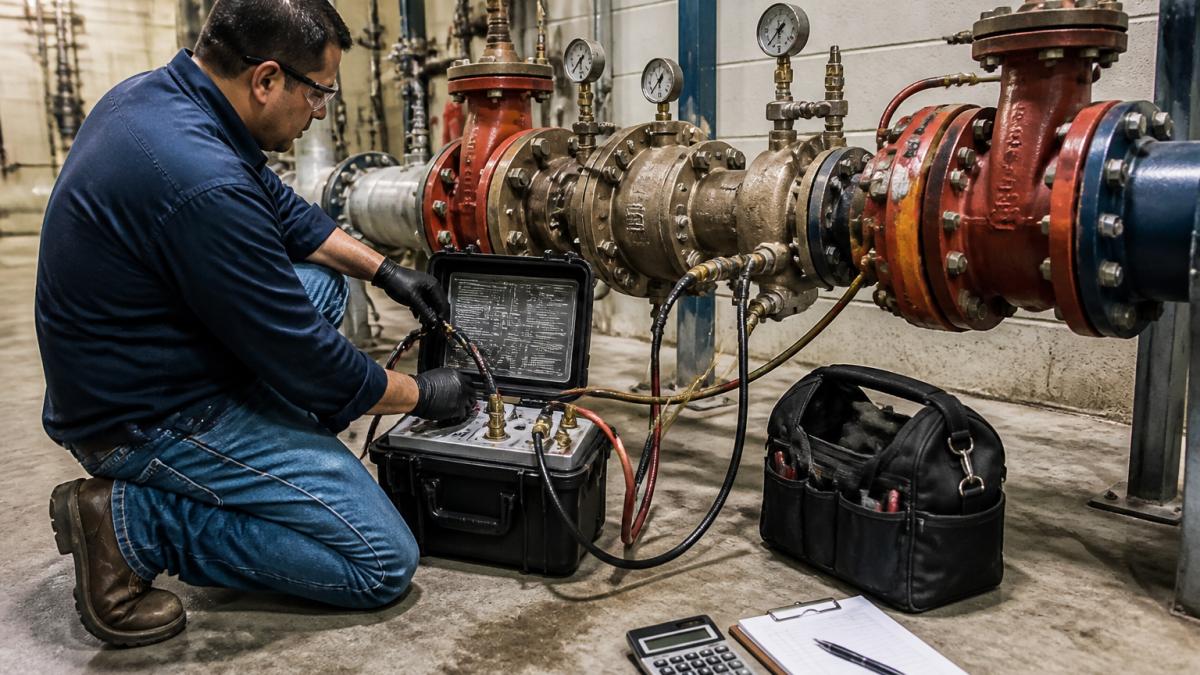
- 3-inch to 4-inch: often two testers, extended gauge kit, longer isolation and return-to-service time.
- 6-inch and above: two testers, sometimes a lift or confined-space entry, and a scheduled shutdown window.
Small Assemblies vs. Large Commercial Devices
The gap between a small and a large device is mostly time, crew size, and equipment:
| Factor | Small Assembly | Large Commercial Device |
|---|---|---|
| Typical setting | Residential irrigation | Fire suppression, industrial |
| Typical diameter | 1/2 inch to 1 inch | 2 inches and up |
| Tester crew | One person | Often two people |
| Time on site | Short | Longer |
| Test kit needs | Standard | Extended gauges |
| Shutdown coordination | Rarely needed | Often required |
| Repair risk | Lower | Higher |
Why Fire-Suppression Assemblies Cost More to Test
Fire suppression backflow assemblies carry a premium for reasons beyond the test itself. The tester usually coordinates with a fire system contractor or building engineer, schedules a shutdown window that does not trip a fire watch requirement, and documents the test so both the fire authority and water authority accept it. That coordination time is labor, which is why a fire-line RPZ test often runs higher than the same-diameter device on an irrigation line.
Commercial Backflow Testing Frequency and Annual Compliance Planning
Commercial backflow testing frequency is usually annual, though some municipalities require testing more often for high-hazard assemblies. Plan around your compliance deadline, not a reminder letter, properties that wait for the notice often pay rush scheduling fees and face a tighter filing window. Spreading tests across the calendar also helps multi-site owners avoid peak-season rates on every device at once.
A certified tester submits the test report to the local water authority, and that reporting step is part of the cost. Confirm who files the paperwork before you book.
Backflow Preventer Repair Cost: What Happens After a Failed Test
Backflow preventer repair cost depends on what failed. A worn check valve or dirty seat may need only a parts replacement and quick retest; a cracked body or corroded assembly can push the job toward full replacement. A failed test is a second bill: the first visit tests, the repair visit fixes, and a third retests, each trip carrying its own labor and service call, so one charge can become three.
Retest Fees and Parts Replacement
Retest fees are common and usually lower than the original test, since the tester already knows the device. Parts replacement is the wild card. Common parts include check valve kits, relief valves, and rubber seals. If the parts are not on the truck, the job stretches to a second trip.
Local Government Fees, Permits, and Reporting Costs
Local government fees vary by municipality and are set by the water authority, not the tester. A city or permit fee may apply to the test, the reporting, or both, so two identical devices in two different cities can carry different totals.
Because these fees change, we do not quote a flat number. Check your local water authority or ask our team for the current requirement in your area.
Multi-Device and Multi-Site Pricing for Commercial Properties
Per-device pricing is the standard model, but volume changes the math. A property with several assemblies can often negotiate a better per-device rate because the tester makes one trip and works through the list, but the savings come from specific mechanisms, not a blanket discount.
Where the Savings Actually Come From
Three cost components shrink when devices are bundled:
- Mobilization and travel. The service call covers the trip to your site. Whether the tester tests one device or six, the drive is the same, the single biggest source of multi-device savings.
- Setup and teardown. Gauges, hoses, and test kits come out once, so setup is amortized across a six-device visit.
- Scheduling and reporting. Filing multiple test reports in one batch takes less administrative time, and some providers pass part of that back.
What does not shrink is the test labor itself. Each device still needs its own isolation, pressure readings, and documentation. That is why a per-device rate rarely drops below the pure labor floor, no matter how many devices you have.
Per-Device Discounts: When They Kick In
Ask for two numbers: the first-device rate and the additional-device rate.
Multi-Site Pricing and Route Density
Multi-site pricing works on the same principle, but route density decides whether you actually save. When one owner holds several commercial properties, a provider can schedule them on one route, cut travel between stops, and pass some savings back, largest when the sites sit close together and can be visited the same day. If your sites are spread across the metro, expect the travel line to eat most of the discount; the better lever is scheduling all sites in the same week so the provider can build an efficient route.
How to Structure the Ask
For owners with many devices, request three things in writing:
- A per-device rate for a single-device visit
- A bundled rate for all devices on one site, tested on one visit
- A multi-site rate that assumes same-week scheduling
Then compare the bundled rate against the per-device rate multiplied out. The bundled rate usually wins when the sites sit close together or the devices sit on one property. It rarely wins when travel between sites is long.
Watch the Mobilization Charge
Confirm whether the bundled rate assumes one visit or several, and get the mobilization charge in writing.
How to Compare Commercial Backflow Testing Quotes
Comparing quotes means reading past the headline number. Two quotes that look identical can hide very different scopes. Use this checklist before you sign:
- Confirm the quoted price covers your assembly type and size
- Ask whether the service call and travel are included or added
- Check if the city fee and reporting fee are separate line items
- Confirm the provider files the test report with the water authority
- Ask the cost of a retest if the device fails
- Get the after-hours and weekend rate in writing
- Verify the tester's certification and license number
- Ask about multi-device or multi-site rates if you own more than one property
Certification is not a detail to skip. A test report is only valid when a certified tester signs it, so an uncertified provider can leave you liable even after you pay. H-Town Backflow holds BP # 0024323, and we file the paperwork so you are not stuck chasing municipal requirements.
Frequently Asked Questions
Why is commercial backflow testing so expensive compared to residential?
Commercial backflow testing typically costs more because commercial assemblies are larger, more complex, and often require specialized test kits and certified testers. Additional factors include higher labor rates for commercial work, more expensive parts for repairs, and local municipal fees that scale with device size. Multi-device properties also add per-device charges. Pricing depends on your specific assembly type, size, and location, so request a quote for an accurate estimate.
Does the size or type of backflow preventer change the testing price?
Yes. A backflow test cost by device size is one of the biggest variables. Smaller residential assemblies (under 1 inch) cost less to test than large commercial devices (2 inches and above). Reduced pressure zone (RPZ) assemblies often cost more to test than double check valves because they have more test ports and require additional pressure readings. Fire suppression system backflow assemblies may also carry different pricing due to access and scheduling requirements.
Are repairs included in the price of a backflow test?
No. The testing fee covers only the inspection and test report submission. If your assembly fails, backflow preventer repair cost is separate and depends on the parts needed and labor time. Common repairs include replacing check valves, relief valves, or rubber kits. Some providers offer a combined test-and-repair rate, but you should confirm what is included before scheduling. Ask whether retest fees apply after repairs.
Can after-hours scheduling affect the cost of commercial backflow testing?
Yes, after-hours or weekend appointments often carry a premium because they require scheduling outside normal business hours. However, some providers offer flexible night and weekend slots without tripling the rate, especially if you book multiple devices or sites together. If avoiding water service interruption is critical for your building, ask about after-hours pricing upfront. The convenience may be worth the additional service call fee.
Commercial backflow compliance does not pause for a busy season, and a missed deadline can put your water service at risk. H-Town Backflow keeps your system compliant with flexible scheduling, including night and weekend appointments that avoid water service interruption, and we handle testing, repair, and reporting across the Greater Houston area and surrounding municipalities. Get started with H-Town Backflow and keep your required testing up to date without the downtime.