 how-to
Managing Municipal Backflow Reporting Requirements
Table of Contents
- What You'll Need Before You Start
- Step 1: Understand Your Annual Backflow Testing Requirements
- Step 2: Hire a Certified Backflow Tester
- Step 3: Complete the Backflow Assembly Test Report Form Correctly
- Step 4: Submit Reports to Your Water Utility on Time
- Troubleshooting Common Submission Errors
- Property Managers vs. Homeowners: Who Handles What
- Digital Compliance Software: Is It Worth the Cost?
- Frequently Asked Questions
Last Updated: September 21, 2026
What You'll Need Before You Start
Managing municipal backflow reporting requirements starts with knowing what documents and details your water utility expects. Backflow reporting is the process of documenting that your backflow prevention assembly was tested by a certified professional and submitting those results to your local water authority on schedule.
Before you begin, gather these items:
- Your device registration number and assembly location
- The assembly type and size (RPZ, DCVA, PVB, and so on)
- Your water utility account number
- Contact details for a certified tester
- Your last test report, if you have one
A common mistake is waiting until the utility sends a notice. By then, you're already behind.
Step 1: Understand Your Annual Backflow Testing Requirements
Annual backflow testing requirements mean your assembly must be tested every 12 months, usually by a certified tester, and the results filed with your water utility. Most municipal ordinances set this as the minimum.
Test frequency can vary based on a few factors:
- Assembly type and hazard level
- Local ordinance rules
- Whether the device serves a commercial or residential property
- Changes to your water system since the last test
How Test Frequency Varies by Assembly Type and Local Ordinance
A reduced pressure principle assembly typically requires annual testing because it protects against the highest health risk. A double check valve assembly may follow the same yearly schedule, but some utilities allow different intervals based on the hazard.
A pressure vacuum breaker on an irrigation system also usually falls under annual testing. Your municipal ordinance is the final word.
Check your utility's rules directly. The EPA's Cross-Connection Control Manual explains why this protection matters for drinking water.
Step 2: Hire a Certified Backflow Tester
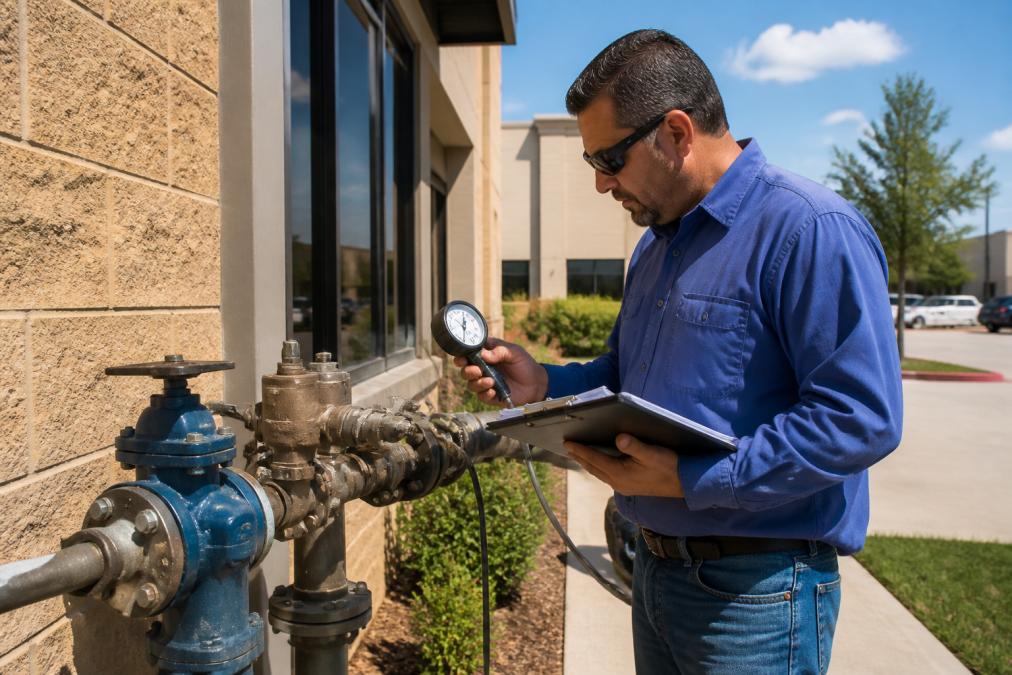
Hiring a certified backflow tester is the step most people rush, and it's the one that causes the most problems later. A certified technician holds a valid certification recognized by your state or municipality.
Ask these questions before you book:
- Are you certified in my city and state?
- Do you carry the right test gauges with current calibration?
- Will you submit the report to my utility, or do I?
- Can you repair the assembly same-day if it fails?
- Do you offer night or weekend appointments?
Questions to Ask Before You Book
The best testers handle the paperwork for you. That matters when you manage multiple properties and can't chase forms.
Step 3: Complete the Backflow Assembly Test Report Form Correctly
The backflow assembly test report form is the official record of your test, and every field must match your utility's records. One wrong digit can get the whole submission kicked back.
Watch these fields closely:
- Device registration number
- Assembly make, model, and size
- Test gauge calibration date
- Tester certification number
- Pass or fail result for each check valve
- Date of test and tester signature
Step 4: Submit Reports to Your Water Utility on Time
Submission deadlines are set by your municipal ordinance, and most utilities give you a short window after the test date, commonly 10 to 30 days. Miss it and you may face a fee, a re-inspection, or a notice of violation.
Follow these steps to submit cleanly:
- Confirm your utility's preferred method (portal, email, or mail)
- Double-check every field on the form
- Submit before the deadline, not on it
- Save a copy of the confirmation
- Log the next due date on your calendar
| Step | What to Do | When |
|---|---|---|
| Register device | File assembly details with utility | At installation |
| Schedule test | Book certified tester | 2-3 weeks before due date |
| Complete form | Tester fills, you review | Test day |
| Submit report | Portal, email, or mail | Before deadline |
| File records | Save confirmation and report | Same day |
What Happens When a Portal Rejects Your Submission
Portals reject filings for predictable reasons. The most common is a device registration number that doesn't match the utility's database, often because the assembly was replaced or re-tagged without updating the record. Other frequent rejections include an expired tester certification, a missing gauge calibration date, or a signature field left blank.
Deadlines by Utility Type
Deadline windows vary by utility size and ordinance. Large municipal utilities often enforce a 10-day window from the test date, while smaller systems may allow 30 days. Some utilities align the deadline with the test anniversary date rather than the submission date. Always check your specific utility's written policy, the ordinance is the final word.
Troubleshooting Common Submission Errors
Most submission errors come down to a handful of fixable problems. Here's how to handle the ones we see most.
If your report was rejected, check these first:
- Wrong device registration number
- Expired tester certification
- Missing gauge calibration date
- Illegible signature or missing date
- Sent to the wrong utility office
Property Managers vs. Homeowners: Who Handles What
Property managers and homeowners face different workloads, but the core duty is the same: keep the test current and the report filed.
For property managers:
- Track every device across every property
- Coordinate tester access and tenant notices
- Keep maintenance records for each assembly
- Watch submission deadlines across multiple utilities
For homeowners:
- Know if you have an assembly (irrigation systems often require one)
- Book a certified tester once a year
- Confirm the report was submitted
- Keep your own copy
Digital Compliance Software: Is It Worth the Cost?
Digital compliance software can help, but only if you manage enough devices to justify it. For a single home, a calendar reminder and a good tester are enough.
For larger portfolios, the math changes. Consider these factors:
- Number of devices you track
- Number of utilities you report to
- Staff time spent chasing forms
- Risk of missed deadlines and penalties
A Simple Cost-Benefit Framework
Most property managers find the break-even point falls somewhere between 20 and 50 devices, depending on how many utilities they report to and how much staff time they spend on compliance. Here's how to run the numbers for your portfolio:
Manual tracking costs:
- Staff hours per device per year (scheduling, form review, submission, follow-up)
- Average loaded hourly rate for that staff
- Penalty exposure per missed deadline (varies by utility, but often exceeds the cost of the test itself)
- Time lost to rejected reports and resubmissions
Software costs:
- Subscription fee (typically per-device or per-portfolio, billed monthly or annually)
- Setup and data migration time
- Training time for staff
- Any per-submission fees some platforms charge
What Software Does Well, and What It Doesn't
H-Town Backflow provides prompt and reliable backflow testing and repair services to ensure your water supply remains safe and free from contaminants. Serving the Greater Houston area and surrounding municipalities, our experienced team helps keep your systems compliant and operating safely. We offer flexible scheduling, including night and weekend appointments, to ensure your operations continue without water service interruption.
Frequently Asked Questions
What records are required for backflow prevention compliance?
You need to keep the original test report from your certified tester, proof of device registration with your water utility, and a record of any repairs or maintenance. Most municipalities require these records for at least three to five years. Your water utility may also ask for the test gauge calibration certificate. Store copies digitally so you can pull them quickly during an inspection or when a submission deadline approaches.
How often do commercial properties need to submit backflow test reports?
Most commercial properties must submit a backflow test report every 12 months. Some assemblies, like reduced pressure principle assemblies in certain high-hazard settings, may need testing more often. Your municipal ordinance sets the exact schedule. Check with your water utility or review your device registration paperwork to confirm your specific test frequency and submission deadline.
What happens if you miss a municipal backflow reporting deadline?
Missing a submission deadline can trigger an enforcement action from your water utility. Penalties may include fines, a notice of violation, or in serious cases, water service termination. Some utilities charge a non-compliance penalty for each month the report is late. If you realize you missed a deadline, contact your utility immediately and submit the overdue report as soon as possible.
Can a certified tester handle the compliance paperwork for me?
Many certified backflow testers submit the completed test report form directly to the water utility on your behalf. This saves you time and reduces the risk of submission errors. Ask your tester upfront whether they handle filing or if the responsibility stays with you. If they do file, request a copy of the submitted report for your maintenance records.
Staying compliant across multiple properties and utilities is a real challenge, and one missed deadline can trigger fees and enforcement. H-Town Backflow makes it simpler with certified testing, same-day repair options, and night or weekend appointments that fit around your operations. Our team serves the City of Houston and surrounding municipalities, so you get a partner who knows the local rules. Get started with H-Town Backflow and keep your system compliant without the guesswork.