 Ultimate guide
Backflow Certification Requirements for Contractors
Table of Contents
- Backflow Certification Requirements for Contractors: The Three Credentials That Matter
- Backflow Tester Certification Requirements by State
- What a Backflow Testing Certification Course Covers
- Backflow Testing Equipment Requirements for Certified Testers
- Backflow Tester Certification Renewal and Continuing Education
- How to Apply, What It Costs, and How Long It Takes
- Annual Testing, Reporting, and Failed-Test Follow-Up
- Frequently Asked Questions
Last Updated: October 20, 2026
Backflow Certification Requirements for Contractors: The Three Credentials That Matter
Backflow certification requirements for contractors hinge on a distinction that trips up a lot of people: tester certification, plumbing licensure, and contractor licensing are three separate credentials from three separate authorities, and holding one does not grant the others.
A backflow tester certification is a credential issued by a state or local authority, or an approved program it recognizes, that authorizes a person to test backflow prevention assemblies and submit test reports to the water purveyor.
Tester Certification vs. Plumbing License vs. Contractor License
Backflow tester certification authorizes a person to test backflow prevention assemblies, record results on the approved form, and submit that report to the water purveyor.
Plumbing licensure authorizes a person to install, repair, and alter plumbing systems under the plumbing code.
Contractor licensing authorizes a business, not just a person, to operate and pull permits. It is a business-level registration separate from individual trade credentials, a certified tester employed by a licensed contractor differs from one running their own shop.
| Credential | Who It Covers | What It Authorizes | Issued By |
|---|---|---|---|
| Tester certification | Individual technician | Testing assemblies and submitting reports | State or local authority, or approved program |
| Plumbing license | Individual tradesperson | Installing and repairing plumbing | State licensing board |
| Contractor license | Business entity | Operating, bidding, pulling permits | State or local contractor board |
Backflow Tester Certification Requirements by State
State rules vary widely, and no single national standard governs who may test. Some states administer certification through a health or environmental agency; others delegate to local water purveyors, so requirements can change from one municipality to the next. A certification earned in one service area may be worthless in the next, so verify eligibility before marketing testing services across municipal lines.
Broadly, state and local backflow regulations fall into three patterns:
- State-administered: a single state agency sets the curriculum, administers or approves the exam, and maintains the certification registry.
- Locally administered: the water purveyor or city sets its own requirements, and a tester may need separate certification or registration for each service area.
- Hybrid: the state sets minimum standards, and local authorities add their own rules on top; the local purveyor still has to recognize the state credential.
How to Compare Requirements Across Jurisdictions
Because requirements are geographically fragmented, the most useful tool a contractor can build is a comparison matrix. Before bidding in a new service area, capture these fields for each jurisdiction in one maintained document:
| Field | What to Record | Why It Matters |
|---|---|---|
| Issuing authority | State agency, local health department, or water purveyor | Determines where applications, renewals, and appeals go |
| Eligibility prerequisite | Plumbing license required, experience hours, or open enrollment | Decides whether you can apply at all |
| Approved training | Named provider or state-recognized course list | An unapproved course is money wasted |
| Exam format | Written only, or written plus practical | Practical exams require scheduling and travel |
| Device types covered | Double-check, reduced pressure zone, pressure vacuum breaker, etc. | Certification scope limits the work you can legally test |
| Renewal cycle | Fixed cycle length and continuing education hours | Drives your compliance calendar |
| Reporting channel | Paper form, online portal, or purveyor-specific system | Determines how test reports are submitted |
| Reciprocity | Whether another jurisdiction's credential is accepted | Controls portability of your certification |
State-administered programs offer the most portability within their borders, while locally administered programs force testers to maintain multiple registrations. Contractors working a single metro area often find the local purveyor's list is the only authority that matters; those crossing state lines need the matrix to avoid assuming reciprocity that does not exist.
Verifying a Jurisdiction's Rules
Do not rely on a course provider's summary of state rules. Confirm requirements directly with the authority that issues the credential or accepts the test report. The U.S. Environmental Protection Agency's cross-connection control guidance is a useful starting point for understanding the public health framework behind these rules, though it does not replace your state or local requirements. When in doubt, call the water purveyor's cross-connection control office and ask two questions: who is authorized to test in this service area, and what form must the report be submitted on.
What a Backflow Testing Certification Course Covers
A backflow testing certification course teaches the hydraulics, code, and test procedures a technician needs in the field. Most approved courses combine classroom hours with hands-on training on the specific device types you will encounter.
Expect the curriculum to cover:
- Cross-connection theory and why backflow occurs
- Backflow prevention device types, including the double-check valve assembly and the reduced pressure zone device
- Test procedures for each device type, including gauge setup and reading interpretation
Hands-On Training and the Written and Practical Exams
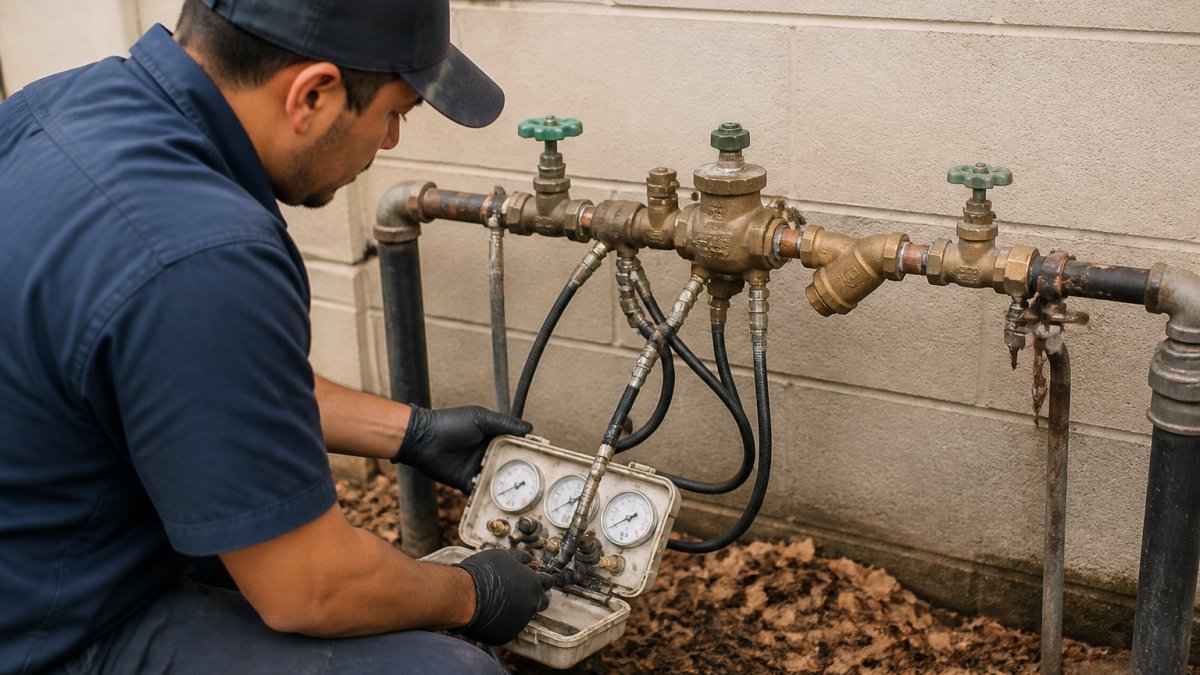
Hands-on training is where most candidates gain confidence or discover a gap. Expect to connect a test kit to a device, run differential pressure readings, and interpret results under supervision.
The written exam tests code, hydraulics, and device theory; the practical exam tests whether you can perform a test correctly and complete the report without errors. Most programs require passing both before issuing certification.
Backflow Testing Equipment Requirements for Certified Testers
The test kit is the critical piece. Gauges must be within calibration, and most jurisdictions require proof on a set schedule. A failed calibration check can invalidate every test report submitted since the last calibration date.
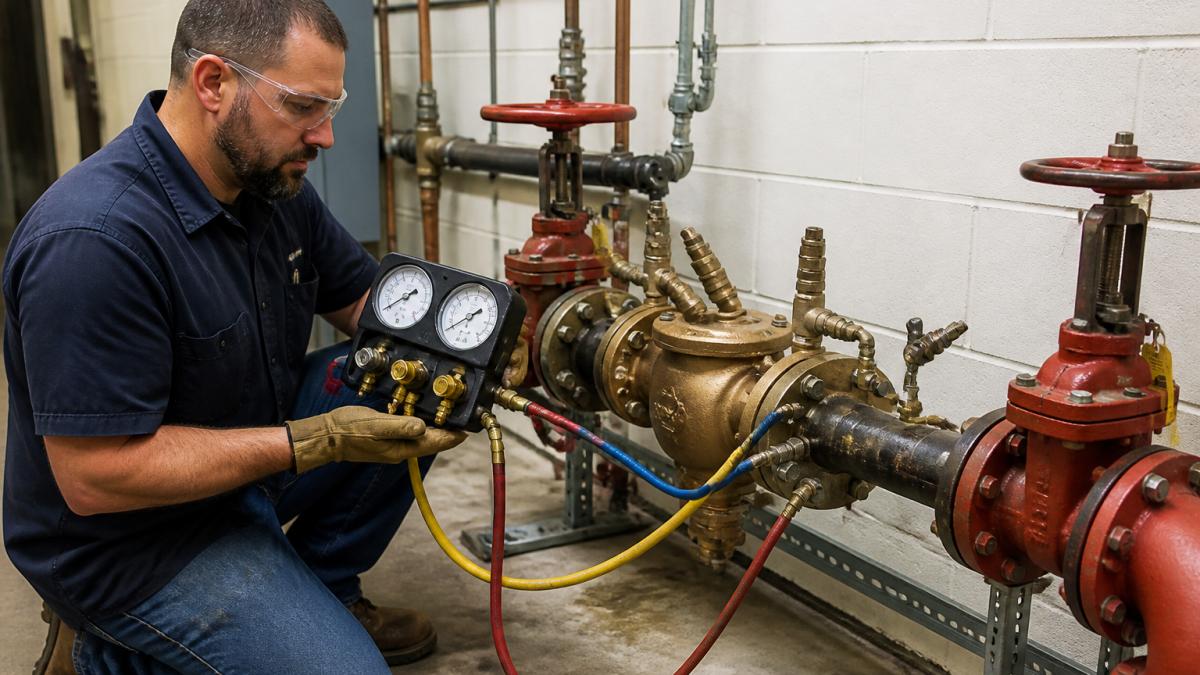
Beyond the kit, keep a compliance checklist for each job: device make and model, serial number, test readings, pass/fail determination, and date. That documentation is what the water purveyor reviews.
Backflow Tester Certification Renewal and Continuing Education
Certification does not last forever. Most jurisdictions require periodic renewal, and many require continuing education hours. Renewal cycles vary, so the only reliable answer is the one your certifying body publishes.
A few rules of thumb that hold across most programs:
- Renewal is typically tied to a fixed cycle, not to the date you passed your exam.
- Continuing education hours are usually required, often focused on code updates and new device types.
- Late renewal may require retesting, not just a fee.
How to Apply, What It Costs, and How Long It Takes
The application process follows a predictable sequence in most jurisdictions:
- Confirm eligibility. Check whether your jurisdiction requires a plumbing license, minimum field experience, or a clean record. This step most often delays applications, because experience documentation can take weeks to assemble.
- Enroll in an approved course. Verify the course is recognized by the authority that will issue your certification; some jurisdictions publish a named list of approved providers.
- Complete the coursework and hands-on training. Attend the classroom hours and supervised practical sessions.
- Pass the written examination. Most programs set a minimum passing score, and some allow one retake. Confirm the retake policy before you sit the exam.
- Pass the practical examination. Demonstrate a correct test on each device type your certification covers. Practical exams are often scheduled separately from the written exam.
- Submit your application and fees. Fees vary by jurisdiction and by the number of device types covered. Ask for the fee schedule in writing.
- Register with the water purveyor. Some jurisdictions require a separate registration before you can submit reports in their service area, a distinct step from certification that is easy to overlook.
What Drives the Cost
Backflow certification costs are the sum of several line items, each varying by jurisdiction and provider:
- Course tuition. The largest single cost, depending on the provider, device types covered, and whether the practical exam is included.
- Examination fees. Written and practical exams may be billed separately, and retakes usually carry an additional fee.
- Application and certification fees. Charged by the issuing authority, sometimes per device type.
Request the fee schedule from the issuing authority and course provider, add the test kit and calibration cost, and budget a contingency for retakes. That total is your realistic cost of entry.
What Drives the Timeline
The time from first inquiry to certification depends on course scheduling, exam availability, and application processing. Smaller jurisdictions may run course sessions only a few times a year, practical exams are often scheduled in batches, and application processing adds delay where experience documentation must be verified.
The calendar, not the coursework, is usually the bottleneck. Build the timeline backward from the date you intend to start bidding testing work, and confirm each step's scheduling lead time with the provider and issuing authority.
For a current look at the regulatory framework behind these requirements, the U.S. Centers for Disease Control and Prevention's drinking water guidance explains why cross-connection control matters to public health.
Annual Testing, Reporting, and Failed-Test Follow-Up
Annual testing is the recurring obligation that keeps a certified tester in business.
When a test fails, the device must be repaired, and a failed test typically triggers a retest before the assembly returns to service.
| Stage | Who Acts | What Gets Documented |
|---|---|---|
| Annual test | Certified tester | Device ID, readings, pass/fail |
| Failed test | Certified tester | Failure readings and notice to owner |
| Repair | Licensed plumber or contractor | Repair scope and parts |
| Retest | Certified tester | Post-repair readings and pass/fail |
| Reporting | Certified tester | Submitted report to water purveyor |
For commercial property managers juggling multiple buildings, the reporting burden is real. That is where working with a provider that handles the paperwork matters.
Backflow compliance is not complicated, but it is unforgiving of gaps.
Frequently Asked Questions
Do you have to be a licensed plumber to test backflow preventers?
Not always, and this is where most contractors get confused. In many jurisdictions a tester certification issued or recognized by the state or the local water purveyor is what authorizes device testing, while a plumbing license governs installation and repair work. Some states require both. Others let a certified tester work under a licensed contractor's business. Check your state's cross-connection control rules and your local water utility's approved tester list before you bid a job, because testing without the right authorization can invalidate the test report.
How often must backflow testers renew their certification?
Renewal cycles vary by jurisdiction. Many certification programs run two to three years, and a growing number require continuing education hours before renewal, often in the range of 8 to 16 hours per cycle. Some water purveyors also require testers to re-apply for their approved tester list annually, separate from the certification itself. Track both dates. Missing a renewal can pull you off an approved tester list and stop you from filing test reports until you reinstate.
What equipment does a certified backflow tester need?
At minimum you need a calibrated differential pressure test kit with the correct gauge range for the devices you test, plus hoses, adapters, and fittings that match local test cock sizes. Most programs also expect a gauge calibration certificate current within 12 months, since an out-of-calibration gauge can void results. Add basic hand tools, a flashlight, and a way to photograph or record readings on site. Some jurisdictions specify acceptable gauge accuracy, so confirm the tolerance your state or water purveyor requires before buying a kit.
How can customers verify a backflow tester's certification?
Ask for the certification number and the issuing body, then check the state licensing board or the water purveyor's published approved tester list. Reputable firms will hand over that information without hesitation. Also confirm the company carries liability insurance and can show a current gauge calibration certificate. In areas with heavy commercial and industrial water use, a tester who appears on the local approved list and can explain the reporting process is a safer bet than one who only quotes a price.
Does a sprinkler system need a backflow preventer?
Yes. An irrigation system is a cross-connection between your drinking water supply and whatever is in the soil, fertilizer, or standing water around the sprinkler heads. Most plumbing codes and local ordinances require an approved backflow prevention device on irrigation lines, and many jurisdictions require annual testing of that device. Residential customers sometimes assume the rule only applies to commercial property, but irrigation assemblies are commonly tested on the same annual schedule.
Can a contractor install a backflow preventer without a permit?
Usually no. Installing a backflow prevention assembly is plumbing work, and most jurisdictions require a plumbing permit and an inspection before the device is placed in service. The installing contractor typically needs the appropriate plumbing or contractor license for that scope, even if a different certified tester performs the annual test afterward. Pulling the permit also creates the record the water purveyor needs to add the device to its testing schedule. Skipping it can cause problems at sale, at insurance review, or when the utility audits the account.